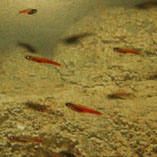
>
Cypriniformes (Carps) >
Paedocyprididae (Tiny carps)
Etymology: Paedocypris: Name from the Greek words 'Paideios' meaning children and 'Cypris' for Venus, common suffix for cyprinid genera; gender feminine; progenetica: Progenetica, progenetic; an adjective.
More on authors: Kottelat, Britz, Tan & Witte.
Entorno: milieu / zona climática / rango de profundidad / gama de distribución
Ecología
; agua dulce bentopelágico. Tropical
Southeast Asia: Indonesia.
Tamaño / Peso / Edad
Madurez: Lm ? range ? - ? cm
Max length : 1.0 cm SL macho / no sexado; (Ref. 56152); 1.0 cm SL (female)
Descripción breve
Claves de identificación | Morfología | Morfometría
Paedocypris progenetica is distinguished from Paedocypris micromegethes by: a smaller maximum size (male 9.8mm, versus 11.6; female 10.3mm, versus 11.4), keratinized pad in front of male pelvic fins as a projecting knob (versus flat to slightly swollen), breeding tubercles on the dentary arranged in a straight row, without forming a cluster (versus forming a cluster of up to five closely set individual tubercles, subdistally on the lateral side of the dentary, supported by a conspicuous lateral bony extension), pelvic fins of female vestigial, or often missing (versus smaller than in male but similarly shaped), presence of pre-anal-fin-fold in female (a character unique among teleosts; versus absent in both sexes), dense small chromatophores in deep layer on abdomen appearing as a continuous patch, tiny black vermiculations on belly from throat to anus, including on male's pre-pelvic keratinized knob (versus large superficial, isolated chromatophores on belly from throat to anus, absent on male's keratinized pad), numerous small, contiguous chromatophores on middorsal line, organized in 3-5 rows, forming a broad stripe (versus few large isolated chromatophores, forming 1-3 irregular rows), pelvic-fin rays plain brown (versus with rows of spots) (Ref. 56152).
One of the smallest fish and vertebrate known, with the smallest mature female measuring a mere 7.9 mm (Ref. 56152).
Ciclo vital y comportamiento de apareamiento
Madurez | Reproducción | Puesta | Huevos | Fecundidad | Larva
Kottelat, M., R. Britz, H.H. Tan and K.-E. Witte, 2005. Paedocypris, a new genus of Southeast Asian cyprinid fish with a remarkable sexual dimorphism, comprises the world's smallest vertebrate. Proc. Royal Soc. Biol. Sci. 273:895-899. (Ref. 56152)
Situación en la Lista Roja de la UICN (Ref. 130435: Version 2025-2 (Global))
Amenaza para el ser humano
Harmless
Usos humanos
Pesquerías: sin interés
Herramientas
Informes especiales
Descargar XML
Fuentes de Internet
Estimaciones basadas en modelos
Índice de diversidad filogenética (Referencia
82804): PD
50 = 0.7500 [Uniqueness, from 0.5 = low to 2.0 = high].
Bayesian length-weight: a=0.00389 (0.00180 - 0.00842), b=3.12 (2.94 - 3.30), in cm total length, based on all LWR estimates for this body shape (Ref.
93245).
Nivel trófico (Referencia
69278): 3.0 ±0.2 se; based on size and trophs of closest relatives
Vulnerabilidad pesquera (Ref.
59153): Low vulnerability (10 of 100).
🛈