Classification / Noms
Noms communs | Synonymes | Catalog of Fishes(Genre, Espèce) | ITIS | CoL | WoRMS | Cloffa
>
Pleuronectiformes (Flatfishes) >
Soleidae (Soles)
Etymology: Aseraggodes: Greek, aggos, -eos, -ous = vessel, uterus, carapace of a crab + Greek, aseros, -a, -on = to remove the appetite (Ref. 45335); firmisquamis: Name from the Latin words 'firmus' (= strong or durable) and 'squama' (= scale), referring to the firmly adhering scales.
More on authors: Randall & Bartsch.
Environnement : milieu / zone climatique / profondeur / gamme de distribution
Écologie
marin démersal; profondeur 1 - 6 m (Ref. 56490). Tropical
Distribution
Territoires | Zones FAO | Écosystèmes | Occurrences | Carte par point | Introductions | Faunafri
Western Pacific: Palau.
Taille / Poids / Âge
Maturité: Lm ? range ? - ? cm
Max length : 3.2 cm SL (female)
Description synthétique
Clés d'identification | Morphologie | Morphométrie
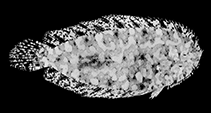
Rayons mous dorsaux (Total) : 66; Rayons mous anaux: 49; Vertèbres: 36. Diagnosis: Dorsal rays 66; anal rays 49, scales partially embedded. Lateral-line scales 74. Vertebrae 10 + 26. Dorsal pterygiophores anterior to fourth neural spine 12. Body depth 2.4 in SL; head length 3.9 in standard length. Snout slightly overlapping lower lip; tubular anterior nostril reaching lower eye when depressed posteriorly; ventral edge of head with a series of about 20 prominent lappet-like cirri. No caudal peduncle; depth at base of caudal fin 2.0 in HL; caudal fin rounded, 3.5 in SL. Longest dorsal ray 1.5 in head length. Large irregular white spots on head, body, and fins, and three rows of blackish spots on body (Ref. 56490).
Body shape (shape guide): short and / or deep.
Cycle de vie et comportement reproducteur
Maturité | Reproduction | Frai | Œufs | Fécondité | Larves
Randall, J.E. and P. Bartsch, 2005. Two new soleid fishes of the genus Aseraggodes from Micronesia, with a record of A. smithi from Palau. Micronesica 38(1):125-139. (Ref. 56490)
Statut dans la liste rouge de l'IUCN (Ref. 130435: Version 2025-2 (Global))
Menace pour l'homme
Harmless
Utilisations par l'homme
Outils
Articles particuliers
Télécharger en XML
Sources Internet
Estimations basées sur des modèles
Indice de diversité phylogénétique (Réf.
82804): PD
50 = 0.5000 [Uniqueness, from 0.5 = low to 2.0 = high].
Bayesian length-weight: a=0.00955 (0.00454 - 0.02011), b=3.07 (2.90 - 3.24), in cm total length, based on LWR estimates for this (Sub)family-body shape (Ref.
93245).
Niveau trophique (Réf.
69278): 3.2 ±0.5 se; based on size and trophs of closest relatives
Résilience (Réf.
120179): Haut, temps minimum de doublement de population inférieur à 15 mois (Preliminary K or Fecundity.).
Vulnérabilité de la pêche (Ref.
59153): Low vulnerability (10 of 100).
🛈