Clasificación / Nombres
Nombres comunes | Sinónimos | Catalog of Fishes(Género, Especie) | ITIS | CoL | WoRMS | Cloffa
>
Siluriformes (Catfishes) >
Cetopsidae (Whale catfishes) > Cetopsinae
Etymology: Cetopsidium: From Cetopsis, the first genus proposed in subfamily Cetopsinae, and 'idium' meaning diminutive, referring to the relatively small body sizes of the members of the genus; ferreirai: Named for Efren J.G. Ferreira of the Instituto Nacional de Pesquisas da Amazonia (INPA), in recognition of his contributions to the knowledge of the fishes of the Brazilian Amazon.
Eponymy: Dr Efrem Jorge Gondim Ferreira (d: 1954) is a Brazilian ichthyologist, who is a Senior Researcher III at Instituto Nacional de Pesquisas da Amazônia, Manaus, and Professor of the Postgraduate Programme in Fresh Water Biology and Inland Fisheries. [...] (Ref. 128868), visit book page.
More on authors: Vari, Ferraris & dePinna.
Entorno: milieu / zona climática / rango de profundidad / gama de distribución
Ecología
; agua dulce bentopelágico. Tropical
South America: Rio Trombetas, left bank tributary of the lower rio Amazonas, Brazil.
Tamaño / Peso / Edad
Madurez: Lm ? range ? - ? cm
Max length : 3.7 cm SL macho / no sexado; (Ref. 56045)
Descripción breve
Claves de identificación | Morfología | Morfometría
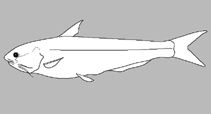
Radios blandos dorsales (total) : 5 - 6; Radios blandos anales: 23 - 24; Vértebra: 39 - 40. Distinguished from all its congeners, possibly except for Cetopsidium roae and C. minutum, by lacking distal filaments on the first rays of the dorsal and pectoral fins in adults males. Differs from C. minutum in the length of the pelvic fin by not reaching anal-fin origin. Further differs from C. morenoi in the overall form of the head, being not massive proportionally as a consequence of the less extensive development of the adductor mandibulae muscle onto the dorsal surface of head and with the snout distinctly rounded, and the less extensive dark pigmentation on the body (near absence of dark pigmentation on the lateral surface of body and the pigmentation limited to the middorsal region of body). Differs from C. orientale in the alignment of the dorsal and ventral profiles of the portion of the body posterior of the base of the dorsal fin (profiles converging posteriorly) and in the overall coloration (limited dark pigmentation located largely along the middorsal region of the body). Distinguished from C. pemon by having profile of head anteriorly rounded and by having proportional length of the snout, approximately 2 times diameter of the eye. Differs from C. roae in the position of the vent, proximate to the base of the anterior most anal-fin ray (Ref. 56045).
Body shape (shape guide): elongated.
Ciclo vital y comportamiento de apareamiento
Madurez | Reproducción | Puesta | Huevos | Fecundidad | Larva
Vari, R.P., C.J. Ferraris Jr. and M.C.C. de Pinna, 2005. The neotropical whale catfishes (Siluriformes: Cetopsidae: Cetopsinae), a revisionary study. Neotrop. Ichthyol. 3(2):127-238. (Ref. 56045)
Situación en la Lista Roja de la UICN (Ref. 130435: Version 2025-2 (Global))
Amenaza para el ser humano
Harmless
Usos humanos
Herramientas
Informes especiales
Descargar XML
Fuentes de Internet
Estimaciones basadas en modelos
Índice de diversidad filogenética (Referencia
82804): PD
50 = 0.5078 [Uniqueness, from 0.5 = low to 2.0 = high].
Bayesian length-weight: a=0.00550 (0.00224 - 0.01349), b=3.13 (2.92 - 3.34), in cm total length, based on LWR estimates for this (Sub)family-body shape (Ref.
93245).
Nivel trófico (Referencia
69278): 3.3 ±0.4 se; based on size and trophs of closest relatives
Vulnerabilidad pesquera (Ref.
59153): Low vulnerability (10 of 100).
🛈