>
Beloniformes (Needle fishes) >
Adrianichthyidae (Ricefishes) > Oryziinae
Etymology: Oryzias: Greek, oryza = rice; because of the habitat used by this fish (Ref. 45335); profundicola: From the Latin profundus (depth) and collere (to inhabit), alluding to the preferred habitat of this species, unusual for oryziids which usually occur close to the surface (Ref. 26687).
More on author: Kottelat.
Environnement : milieu / zone climatique / profondeur / gamme de distribution
Écologie
; eau douce benthopélagique; pH range: 7.5 - 8.5; non migrateur. Tropical; 22°C - 25°C (Ref. 31267)
Asia: Indonesia.
Taille / Poids / Âge
Maturité: Lm ? range ? - ? cm
Max length : 6.0 cm TL mâle / non sexé; (Ref. 31267); common length : 5.0 cm TL mâle / non sexé; (Ref. 27139)
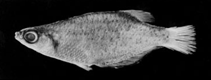
Rayons mous dorsaux (Total) : 10 - 14; Rayons mous anaux: 26 - 29. Distinguished from all other species of the genus by the following characters: 26-29 anal rays; 10-14 dorsal rays; and body depth 30-35% SL. These are unique characters except for dorsal ray counts for which the counts of 10-12 are shared with other species (Ref. 26687).
Body shape (shape guide): elongated.
Adults occur along gently sloping shores with large boulders on sand and pebble bottom (Ref. 26687). Found only below 1.5 m and in small groups of 2-20 individuals (Ref. 26687). Non-annual breeders (Ref. 27139).
Cycle de vie et comportement reproducteur
Maturité | Reproduction | Frai | Œufs | Fécondité | Larves
Kottelat, M., 1990. The ricefishes (Oryziidae) of the Malili Lakes, Sulawesi, Indonesia, with description of a new species. Ichthyol. Explor. Freshwat. 1(2):151-166. (Ref. 26687)
Statut dans la liste rouge de l'IUCN (Ref. 130435: Version 2025-2 (Global))
Menace pour l'homme
Harmless
Utilisations par l'homme
Pêcheries: sans intérêt
Outils
Articles particuliers
Télécharger en XML
Sources Internet
Estimations basées sur des modèles
Indice de diversité phylogénétique (Réf.
82804): PD
50 = 0.5000 [Uniqueness, from 0.5 = low to 2.0 = high].
Bayesian length-weight: a=0.00479 (0.00190 - 0.01207), b=3.13 (2.91 - 3.35), in cm total length, based on LWR estimates for this (Sub)family-body shape (Ref.
93245).
Niveau trophique (Réf.
69278): 3.5 ±0.5 se; based on size and trophs of closest relatives
Résilience (Réf.
120179): Faible, temps minimum de doublement de population : 4,5 à 14 années (Assuming fec < 100).
Vulnérabilité de la pêche (Ref.
59153): Low vulnerability (10 of 100).
🛈