Classificação / Nomes
Nomes comuns | Sinónimos | Catalog of Fishes(Género, Espécies) | ITIS | CoL | WoRMS | Cloffa
>
Cichliformes (Cichlids, convict blennies) >
Cichlidae (Cichlids) > Pseudocrenilabrinae
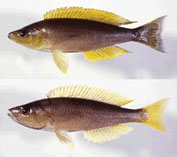
Etymology: Cyprichromis: Latin, cyprinus = carp + Greek, chromis = a fish, perhaps a perch (Ref. 45335); coloratus: The species name, coloratus, is derived from the Latin, in reference to the colourful fins of males (Ref. 57033).
Ambiente: milieu / zona climática / intervalo de profundidade / gama de distribuição
Ecologia
; Água doce pelágico(a,os,as); intervalo de profundidade 5 - 60 m (Ref. 57033), usually 15 - 35 m (Ref. 57033). Tropical
Africa: endemic to Lake Tanganyika, occurs in the southern part of the lake, off Wonzye Point, Kasenga and Nkumbula Island in Zambia (Ref. 57033).
Tamanho / Peso / Idade
Maturidade: Lm ? range ? - ? cm
Max length : 10.3 cm SL macho/indeterminado; (Ref. 57033); 9.2 cm SL (female)
Descrição breve
Chaves de identificação | Morfologia | Morfometria
Recognized as a species of the genus Cyprichromis by the elongate abdominal
cavity, extending posteriorly beyond the anal fin origin. Cyprichromis coloratus n. sp. can be distinguished from C. microlepidotus by fewer scales in the longitudinal line (41-44 v. 59-70 in C. microlepidotus) and in the upper lateral line (31-36 v. 47-59), from C. leptosoma by more spines in the dorsal fin (14-15 v. 11–13 in C. leptosoma) and more scales in the longitudinal line (41-44 v. 38-40), from C. pavo by fewer dorsal-fin spines and soft rays (total number of spines and soft rays 29-31, usually 30, v. 30-32, usually 31, in C. pavo), and from C. zonatus usually by a shallower body [body depth 24.0–28.5 (26.4 +/- 1.1) % LS v. 24.5–30.5 (28.4 +/- 1.3) % in C. zonatus] and smaller eye (eye length (LE)
25.2–30.9 (27.2 +/- 1.1) % of head length (LH) v. 27.9–33.3 (30.2 +/- 1.2) %). Males of the new species are also distinguished from C. microlepidotus, C. pavo and C. zonatus by the following colouration features: absence of distinct small spots on body (v. presence of pearl grey and yellowish small spots along scale rows on body in C. microlepidotus and C. pavo), dichromatism (particularly of the caudal fin) in males of the same population (v. no dichromatism in C. zonatus), and absence of vertical bands on flanks (v. three or four distinct vertical bands beneath dorsal fin base in live males of C. zonatus) (Ref. 57033).
Body shape (shape guide): fusiform / normal; Cross section: oval.
Occurs exclusively over rocky substratum, 1-5 m above the bottom from 5 m to at least 35 m depth; most abundant at ca. 15 m depth; females and sub-adult males forms mixed-species schools; adult males each maintain territories above adjacent large rocks or boulders; feed almost exclusively on cyploploid copepodids; mouthbrooding females (Ref. 57033).
Ciclo de vida e comportamento de acasalamento
Maturidade | Reprodução | Desova | Ovos | Fecundidade | Larvas
Takahashi, T. and M. Hori, 2006. Description of a new Lake Tanganyikan cichlid fish of the genus Cyprichromis (Perciformes: Cichlidae) with a note on sexual dimorphism. J. Fish Biol. 68(Suppl.B):174-192. (Ref. 57033)
Categoria na Lista Vermelha da IUCN (Ref. 130435: Version 2025-2 (Global))
Ameaça para o homem
Harmless
Utilização humana
Ferramentas
Relatórios especiais
Descarregue XML
Fontes da internet
Estimativas baseadas em modelos
Índice de diversidade filogenética (Ref.
82804): PD
50 = 0.5312 [Uniqueness, from 0.5 = low to 2.0 = high].
Bayesian length-weight: a=0.01445 (0.00671 - 0.03113), b=2.99 (2.82 - 3.16), in cm total length, based on LWR estimates for this (Sub)family-body shape (Ref.
93245).
Nível Trófico (Ref.
69278): 3.5 ±0.5 se; based on size and trophs of closest relatives
Resiliência (Ref.
120179): Elevada, tempo mínimo de duplicação da população menor que 15 meses (Preliminary K or Fecundity.).
Vulnerabilidade da pesca (Ref.
59153): Low vulnerability (10 of 100).
🛈