Classification / Noms
Noms communs | Synonymes | Catalog of Fishes(Genre, Espèce) | ITIS | CoL | WoRMS | Cloffa
>
Gobiiformes (Gobies) >
Gobiidae (Gobies) > Sicydiinae
Etymology: Sicyopus: Greek, sika, sikya = cucumber + Greek, pous = foot (Ref. 45335); exallisquamulus: From the Greek exallos, meaning special, distinguishing, and the Latin squamulus, meaning diminutive form for scales, in reference to the small and sexually dimorphic scales found on the abdomen.
More on authors: Watson & Kottelat.
Environnement : milieu / zone climatique / profondeur / gamme de distribution
Écologie
; eau douce démersal. Tropical
Asia: Island od Halmahera in Maluku, Indonesia.
Taille / Poids / Âge
Maturité: Lm ? range ? - ? cm
Max length : 5.1 cm SL mâle / non sexé; (Ref. 57053)
Description synthétique
Clés d'identification | Morphologie | Morphométrie
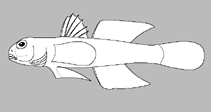
Épines dorsales (Total) : 7; Rayons mous dorsaux (Total) : 9 - 10; Épines anales: 1; Rayons mous anaux: 9 - 10. Pectoral fin with 14-15 rays. Both sexes with small widely spaced scales ventral to first dorsal fin, ctenoid in male, cycloid in female. Both sexes with lobes associated with urogenital papilla. In male, first dorsal fin with spines 3 and or 4 sometimes filamentous (Ref. 57053).
Body shape (shape guide): fusiform / normal.
Inhabits swift, clear high gradient streams with rocky and boulder strewn bottom (Ref. 57053).
Cycle de vie et comportement reproducteur
Maturité | Reproduction | Frai | Œufs | Fécondité | Larves
Watson, R.E. and M. Kottelat, 2006. Two new freshwater gobies from Halmahera, Maluku, Indonesia (Teleostei: Gobioidei: Sicydiinae). Ichthyol. Explor. Freshwat. 17(2):121-128. (Ref. 57053)
Statut dans la liste rouge de l'IUCN (Ref. 130435: Version 2025-2 (Global))
Menace pour l'homme
Harmless
Utilisations par l'homme
Outils
Articles particuliers
Télécharger en XML
Sources Internet
Estimations basées sur des modèles
Indice de diversité phylogénétique (Réf.
82804): PD
50 = 0.5005 [Uniqueness, from 0.5 = low to 2.0 = high].
Bayesian length-weight: a=0.01122 (0.00514 - 0.02450), b=3.04 (2.87 - 3.21), in cm total length, based on all LWR estimates for this body shape (Ref.
93245).
Résilience (Réf.
120179): Haut, temps minimum de doublement de population inférieur à 15 mois (Preliminary K or Fecundity.).
Vulnérabilité de la pêche (Ref.
59153): Low vulnerability (10 of 100).
🛈