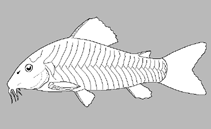
Klassifizierung / Names
Namen | Synonyme | Catalog of Fishes(Gattung, Arten) | ITIS | CoL | WoRMS | Cloffa
>
Siluriformes (Catfishes) >
Callichthyidae (Callichthyid armored catfishes) > Corydoradinae
Etymology: Aspidoras: Greek, aspis, -idos = shield + Greek, dora = skin (Ref. 45335); psammatides: Named after "Psammatos psammatides", the sand sorcerer, a characer of the J.R.R. Tolkien's book "Roverandom", from the Greek psammos, meaning sand, and ides, meaning son of. In allusion to the sand-dwelling behavior of the species.
Umwelt: Milieu / Klimazone / Tiefenbereich / Verbreitungsgebiet
Ökologie
; süßwasser demersal. Tropical
South America: Brazil.
Größe / Gewicht / Alter
Geschlechtsreife: Lm ? range ? - ? cm
Max length : 3.1 cm SL Männchen/unbestimmt; (Ref. 57143)
Kurzbeschreibung
Bestimmungsschlüssel | Morphologie | Morphometrie
Rückenflossenstacheln (insgesamt) : 1; Rückenflossenweichstrahlen (insgesamt) : 8. This species is distinguished by the following characters: with extremely narrow frontal bone, its width conspicuously smaller than half of its entire length; anterior portion of infraorbital 1 with strongly reduced laminar expansion, not reaching or at same level as posterior margin of nasal capsule; presence of dorsal-fin spinelet (Ref. 129024).
Body shape (shape guide): elongated; Cross section: oval.
Facultative air-breathing (Ref. 126274); Inhabits highly transparent brownish water (tea colored), up to one meter depth, with moderate current, and substrate composed of sand, gravel and larger rocks (typical at the rio Capivara, a tributary to the rio Paraguaçu basin). Found in syntopy with Characidium clistenesi, and both species were observed to forage next to each other, with no conspicuous interactions (Ref. 129024).
Lebenszyklus und Paarungsverhalten
Geschlechtsreife | Fortpflanzung | Ablaichen | Eier | Fruchtbarkeit | Larven
Britto, M.R., F.C.T. Lima and A.C.A. Santos, 2005. A new Aspidoras (Siluriformes: Callichthyidae) from rio Paraguaçu basin, Chapada Diamantina, Bahia, Brazil. Neotrop. Ichthyol. 3(4):473-479. (Ref. 57143)
IUCN Rote Liste Status (Ref. 130435: Version 2025-2 (Global))
Bedrohung für Menschen
Harmless
Nutzung durch Menschen
Tools
Zusatzinformationen
Download XML
Internet Quellen
Schätzungen auf der Grundlage von Modellen
Phylogenetischer Diversitätsindex (Ref.
82804): PD
50 = 0.5000 [Uniqueness, from 0.5 = low to 2.0 = high].
Bayesian length-weight: a=0.00741 (0.00287 - 0.01912), b=3.14 (2.92 - 3.36), in cm total length, based on LWR estimates for this (Sub)family-body shape (Ref.
93245).
Trophische Ebene (Ref.
69278): 3.0 ±0.3 se; based on size and trophs of closest relatives
Widerstandsfähigkeit (Ref.
120179): hoch, Verdopplung der Population dauert weniger als 15 Monate. (Preliminary K or Fecundity.).
Anfälligkeit der Fischerei (Ref.
59153): Low vulnerability (10 of 100).
🛈