>
Gobiiformes (Gobies) >
Gobiidae (Gobies) > Gobiinae
Etymology: Trimma: Greek, trimma, -atos = something crushed (Ref. 45335); anthrenum: From the Greek word 'anthrene', a wild bee, wasp or hornet, referring to its aposematic coloration of yellow with black stripes.
More on author: Winterbottom.
Ambiente: milieu / zona climatica / distribuzione batimetrica / gamma di distribuzione
Ecologia
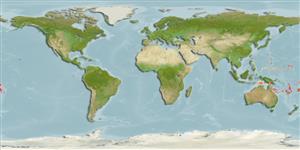
marino associati a barriera corallina; distribuzione batimetrica 5 - 76 m (Ref. 57544). Tropical
Western Pacific: Fiji and Tonga.
Dimensione / Peso / Età
Maturità: Lm ? range ? - ? cm
Max length : 2.0 cm SL maschio/sesso non determinato; (Ref. 57544); 2.0 cm SL (female)
Breve descrizione
Chiavi di identificazione | Morfologia | Morfometria
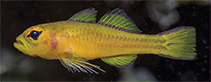
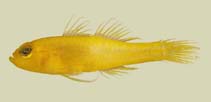
Spine dorsali (totale) : 7; Raggi dorsali molli (totale) : 8 - 9; Spine anali: 1; Raggi anali molli: 7 - 9. Diagnosis: Characterized by the presence of scales in the predorsal midline; second and third dorsal spines either slightly or not elongate; an unbranched fifth pelvic fin ray; both interorbital and postorbital trenches moderately well developed; and the absence of opercular scales. Scale margins of preserved specimens are very finely outlined with melanophores across the top half of the body, which is otherwise almost devoid of visible pigment cells. When alive, it has a yellow body, and the iris has a pair of blue and black triangles with their bases against the anterior and posterior margins of the pupil (giving the pupil a slit-like appearance), the posterior triangle continues anteroventrally around the pupil margin. Both living and preserved specimens have a dark basal stripe in the medial fins and a blaze of brown pigment on the upper part of the pectoral-fin base (Ref. 57544).
Body shape (shape guide): fusiform / normal.
Ciclo vitale e comportamento di accoppiamento
Maturità | Riproduzione | Deposizione | Uova | Fecondità | Larve
Winterbottom, R., 2006. Two new species of the gobiid fish Trimma from the coral reefs of the western Pacific Ocean (Pisces; Perciformes; Gobioidei). Zootaxa 1331:55-68. (Ref. 57544)
Stato della Lista Rossa IUCN (Ref. 130435: Version 2025-2 (Global))
Minaccia per l'uomo
Harmless
Usi umani
Pesca: di nessun interesse
Strumenti
Rapporti speciali
Scarica XML
Fonti Internet
Stime basate su modelli
Temperatura preferita (Fonte Biblio.
123201): 25.4 - 28.7, mean 27.3 °C (based on 124 cells).
Indice di diversità filogenetica (Fonte Biblio.
82804): PD
50 = 0.5000 [Uniqueness, from 0.5 = low to 2.0 = high].
Bayesian length-weight: a=0.01023 (0.00477 - 0.02194), b=3.01 (2.83 - 3.19), in cm total length, based on LWR estimates for this (Sub)family-body shape (Ref.
93245).
Resilienza (Fonte Biblio.
120179): Alto, tempo minimo di raddoppiamento della popolazione meno di 15 mesi (Preliminary K or Fecundity.).
Vulnerabilità della pesca (Ref.
59153): Low vulnerability (10 of 100).
🛈