>
Gobiiformes (Gobies) >
Thalasseleotrididae (Ocean sleepers)
Etymology: Thalasseleotris: Greek, thalassa = the sea + The name of a Nile fish, eleotris (Ref. 45335); iota: Name from the Greek word 'iota' meaning very small, referring to its size.
More on authors: Hoese & Roberts.
Ambiente: milieu / zona climática / intervalo de profundidade / gama de distribuição
Ecologia
marinhas associadas(os) a recifes; intervalo de profundidade 2 - 34 m (Ref. 57647). Tropical
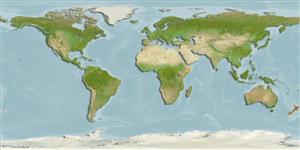
Southwest Pacific: New Zealand.
Tamanho / Peso / Idade
Maturidade: Lm ? range ? - ? cm
Max length : 3.3 cm SL macho/indeterminado; (Ref. 57647)
Descrição breve
Chaves de identificação | Morfologia | Morfometria
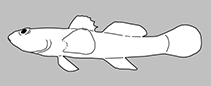
Espinhos dorsais (total) : 7 - 8; Raios dorsais moles (total) : 8 - 10; Espinhos anais: 1; Raios anais moles: 7 - 9. Diagnosis: This species differs from T. adela Hoese & Larson, 1987, in having a narrower gill opening, extending forward to below posterior margin of eye or slightly behind eye (vs. under middle of eye); less extensively scaled body, with naked area reaching to below second dorsal origin or beyond (vs. near end of first dorsal fin); higher transverse scale count (usually 7 - 8 vs. 6 - 7); modally lower vertebral count (10+16 vs. 10+17); anterior nasal tube distinctly longer than posterior nasal tube (vs. subequal); two anal pterygiophores before first haemal spine (vs. 1); uppermost scale and lowermost scale on base of caudal fin with enlarged peripheral cteni (vs. no enlarged peripheral cteni). There are several color differences, including: lacking a black spot posteriorly on the first dorsal fin; usually 5 - 6 small black more or less rounded spots on the ventral midline of the caudal peduncle (vs. usually 4 horizontally elongate black spots); a broad black or dark brown area on basal third of pectoral fin (vs. no distinct black area or a small black spot dorsally on proximal upper 2 - 3 rays); dorsal, anal, and caudal fins with thin wavy grey lines (vs. uniformly pigmented); and no dark dorsomedian line on band before first dorsal fin (Ref. 57647).
Observed to be solitary and possibly, a territorial species. Inhabits broken rocky reefs with holes, crevices, and small caves; perches on rocky ledges partly overlain by silty sand or shell debris. Reported to be often collected underwater sharing caves with much larger black gobies Gobiopsis atrata. Its small size, cryptic habit, semi-transparency, and camouflage coloration make this fish very difficult to locate underwater; though readily collected with rotenone ichthyocide while scuba diving. The habitat of this species in New Zealand is very similar to that of T. adela in Australia, which is restricted to rocky reefs, often in silty turbid waters, at 1-24 m depth. May be collected using slurp gun or hand collected following controlled use of rotenone ichthyocide (Ref. 57647).
Ciclo de vida e comportamento de acasalamento
Maturidade | Reprodução | Desova | Ovos | Fecundidade | Larvas
Hoese, D.F. and C.D. Roberts, 2005. A new species of the eleotrid genus Thalasseleotris (Teleostei: Gobioidei) from New Zealand coastal waters. J. R. Soc. N. Z. 35(4):417-431. (Ref. 57647)
Categoria na Lista Vermelha da IUCN (Ref. 130435: Version 2025-2 (Global))
Ameaça para o homem
Harmless
Utilização humana
Pescarias: de interesse potencial
Ferramentas
Relatórios especiais
Descarregue XML
Fontes da internet
Estimativas baseadas em modelos
Índice de diversidade filogenética (Ref.
82804): PD
50 = 0.8125 [Uniqueness, from 0.5 = low to 2.0 = high].
Bayesian length-weight: a=0.00389 (0.00180 - 0.00842), b=3.12 (2.94 - 3.30), in cm total length, based on all LWR estimates for this body shape (Ref.
93245).
Nível Trófico (Ref.
69278): 3.1 ±0.4 se; based on size and trophs of closest relatives
Vulnerabilidade da pesca (Ref.
59153): Low vulnerability (10 of 100).
🛈