Klassifizierung / Names
Namen | Synonyme | Catalog of Fishes(Gattung, Arten) | ITIS | CoL | WoRMS | Cloffa
>
Gobiiformes (Gobies) >
Gobiidae (Gobies) > Gobiinae
Etymology: Amblyeleotris: Greek, amblys = darkness + The name of a Nile fish, eleotris (Ref. 45335); ellipse: Named for the English and French for geometric figure, referring to the large elliptical mark on the caudal fin; noun in apposition.
More on author: Randall.
Umwelt: Milieu / Klimazone / Tiefenbereich / Verbreitungsgebiet
Ökologie
seewasser demersal; tiefenbereich 23 - 32 m (Ref. 57552). Tropical
Eastern Central Pacific: American Samoa.
Größe / Gewicht / Alter
Geschlechtsreife: Lm ? range ? - ? cm
Max length : 4.4 cm SL Männchen/unbestimmt; (Ref. 57552); 4.4 cm SL (female)
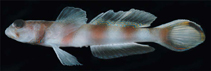
Rückenflossenstacheln (insgesamt) : 7; Rückenflossenweichstrahlen (insgesamt) : 13; Afterflossenstacheln: 1; Afterflossenweichstrahlen: 13. Diagnosis: Dorsal rays VI-I, 13; anal rays 1, 13; pectoral rays 19-20 (usually 19); pelvic fins joined by a short membrane at base, with no frenum; fifth pelvic ray longest, branched once, the branches not separated. Longitudinal scale series 80-89; no median predorsal or prepectoral scales; scales on side of nape extending to above middle of opercle. Gill opening extending forward to below middle of preopercle. Body depth 5.55-6.15 in SL; head length (HL) 3.25-3.45 in SL; caudal fin rounded and moderately long, 2.8-3.1 in SL. Pale yellow dorsally, white ventrally, densely spotted with small pale blue spots; three broad dusky red bars on body, and a narrower darker one from nape across opercle and throat, broadly bordered by yellow containing small blue spots; a faint brown bar across posterior caudal peduncle, merging with brownish red of caudal fin base; second dorsal and anal fins with a broad longitudinal dusky band, the second dorsal yellow at base with dark-edged blue markings, the anal white at base with a broad yellow margin containing dark-edged blue markings; caudal fin with a large blue-edged elliptical mark that varies in zones from brownish orange to orange red, yellow, and black (Ref. 57552).
Body shape (shape guide): elongated.
Inhabits sandy areas, near reefs, and lives symbiotically in a burrow with an alpheid shrimp (Ref. 57552).
Lebenszyklus und Paarungsverhalten
Geschlechtsreife | Fortpflanzung | Ablaichen | Eier | Fruchtbarkeit | Larven
Randall, J.E., 2004. Five new shrimp gobies of the genus Amblyeleotris from islands of Oceania. aqua, J. Ichthyol. Aquat. Biol. 8(2):61-78. (Ref. 57552)
IUCN Rote Liste Status (Ref. 130435: Version 2025-2 (Global))
Bedrohung für Menschen
Harmless
Nutzung durch Menschen
Tools
Zusatzinformationen
Download XML
Internet Quellen
Schätzungen auf der Grundlage von Modellen
Phylogenetischer Diversitätsindex (Ref.
82804): PD
50 = 0.5000 [Uniqueness, from 0.5 = low to 2.0 = high].
Bayesian length-weight: a=0.00741 (0.00347 - 0.01582), b=3.09 (2.91 - 3.27), in cm total length, based on LWR estimates for this (Sub)family-body shape (Ref.
93245).
Trophische Ebene (Ref.
69278): 3.2 ±0.3 se; based on size and trophs of closest relatives
Widerstandsfähigkeit (Ref.
120179): hoch, Verdopplung der Population dauert weniger als 15 Monate. (Preliminary K or Fecundity.).
Anfälligkeit der Fischerei (Ref.
59153): Low vulnerability (10 of 100).
🛈