Classificatie / Namen
Lokale namen | Synoniemen | Catalog of Fishes(Genus, Soort(en)) | ITIS | CoL | WoRMS | Cloffa
>
Pleuronectiformes (Flatfishes) >
Soleidae (Soles)
Etymology: Aseraggodes: Greek, aggos, -eos, -ous = vessel, uterus, carapace of a crab + Greek, aseros, -a, -on = to remove the appetite (Ref. 45335); lenisquamis: Name from the Latin words 'lenis' for soft or smooth and 'squamma' fro scale, referring to the distinctive scale structure; cteni nearly covered by soft epidermal tissue, only the tips exposed at the scale margin.
More on author: Randall.
Milieu: milieu / Klimaatzone / Diepte / verspreidingsgebied
Ecologie
marien; brak water demersaal; diepte 4 - 10 m (Ref. 57560). Subtropical
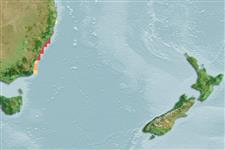
Southwestern Pacific: New South Wales, Australia.
Grootte / Gewicht / Leeftijd
Maturiteit: Lm ? range ? - ? cm
Max length : 10.2 cm SL mannelijk / geslacht onbekend; (Ref. 57560)
Korte beschrijving
Determinatiesleutels | Morfologie | Morfometrie
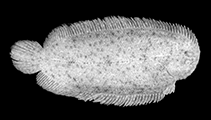
Dorsale zachte stralen (totaal) : 62 - 70; Anale zachte stralen: 46 - 52; Wervels: 36 - 38. Diagnosis: Dorsal rays 62-70; anal rays 46-52; dorsal and anal rays branched. Lateral-line scales 62-68. including 8-9 anterior to a vertical at upper end of gill opening. Vertebrae 36-38; dorsal pterygiophores anterior to fourth neural spine 8-9. Body depth 2.4-2.65 in SL; head short, its length (HL) 4.75-5.05 in SL; eye diameter 4.6-5.7 in HL; upper eye overlapping about anterior one-third to one-half of lower eye; interorbital space variable in width; vertical distance separating eyes 7.3-13.7 in HL. Caudal peduncle absent. Lappet-like cirri on ventral edge of head, but not on front of snout; numerous cirri on opercular edge of gill opening on both sides; dense cirri over much of ventral part of head; exposed surface of scales overlaid with soft tissue; only tips of cirri visible at scale margins, capped with soft tissue; lateral-line scales with fleshy cirri, often one above and one below pore (cirri better developed on ocular than blind side); scattered other scales with a slender fleshy cirrus, often one from each corner of scale; membranous ridges of both sides of dorsal and anal rays with a conspicuous fringe of cirri. Some of which are bifid. Lateral line aligned with upper eye. Longest dorsal ray 1.65-1.8 in HL. Caudal fin rounded, its length 4.6-5.05 in SL; pelvic fins short, 1.8-2.2 in HL, the tip of longest ray reaching base of second anal ray. Ocular side light brown, with scattered small dark brown blotches; rays of fins with small dark brown spots (Ref. 57560).
Body shape (shape guide): short and / or deep.
Collected from sand in bays (Ref. 57560).
Levenscyclus en paargedrag
Maturiteit | Voortplanting | Paaien | Eieren | Fecunditeit | Larven
Randall, J.E., 2005. A review of soles of the genus Aseraggodes from the South Pacific, with descriptions of seven new species and a diagnosis of Synclidopus. Memoirs of Museum Victoria 62(2):191-212. (Ref. 57560)
Status op de Rode Lijst van het IUCN (Ref. 130435: Version 2025-2 (Global))
Gevaar voor de mens
Harmless
Gebruik door de mens
Tools
Speciale rapporten
Download XML
Internetbronnen
Schattingen op basis van modellen
Gewenste temperatuur (Ref.
123201): 17.8 - 23.3, mean 18.8 °C (based on 40 cells).
Fylogenetische diversiteitsindex (Ref.
82804): PD
50 = 0.5000 [Uniqueness, from 0.5 = low to 2.0 = high].
Bayesian length-weight: a=0.00955 (0.00454 - 0.02011), b=3.07 (2.90 - 3.24), in cm total length, based on LWR estimates for this (Sub)family-body shape (Ref.
93245).
Trofisch niveau (Ref.
69278): 3.6 ±0.5 se; based on size and trophs of closest relatives
Weerstandsvermogen (Ref.
120179): Hoog, minimale populatieverdubbelingstijd minder dan 15 maanden (Preliminary K or Fecundity.).
Kwetsbaarheid van de visserij (Ref.
59153): Low vulnerability (10 of 100).
🛈