Klassifizierung / Names
Namen | Synonyme | Catalog of Fishes(Gattung, Arten) | ITIS | CoL | WoRMS | Cloffa
>
Gobiiformes (Gobies) >
Gobiidae (Gobies) > Gobiinae
Etymology: caudilinea: Named for the dark line that nearly crosses the base of the caudal fin, it is the most consistent color marking.
More on author: Randall.
Umwelt: Milieu / Klimazone / Tiefenbereich / Verbreitungsgebiet
Ökologie
seewasser demersal; tiefenbereich 0 - 40 m (Ref. 54354). Tropical
Eastern Pacific: Easter Island.
Größe / Gewicht / Alter
Geschlechtsreife: Lm ? range ? - ? cm
Max length : 2.8 cm SL Männchen/unbestimmt; (Ref. 54354); 2.8 cm SL (female)
Kurzbeschreibung
Bestimmungsschlüssel | Morphologie | Morphometrie
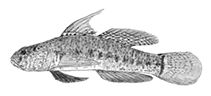
Rückenflossenstacheln (insgesamt) : 7; Rückenflossenweichstrahlen (insgesamt) : 8 - 9; Afterflossenstacheln: 1; Afterflossenweichstrahlen: 8; Wirbelzahl: 27. This species is characterized by the following: D VI-I,8-9 (rarely 8), the 6th spine linked basally by membrane with spine at front of soft portion of fin; A 1,8; pectoral rays 20 or 21; branched caudal rays 14; pelvic fins fully separated, rays I, 5, fifth ray unbranched or branched once at tip, the distance between bases of inner rays of 2 fins about equal to base of either fin. Scales ctenoid except a few cycloid anteriorly and ventrally on abdomen; longitudinal scale series 24-29; no scales on head, nape, prepectoral area, or chest. Body depth 4.2-5.3 in SL; head length 3.05-3.1 in SL. No opening above the first gill arch (occluded by membrane); lower end of gill opening at level of ventral edge of pectoral-fin base. Posterior nostril not tubular. Sensory papillae of cheek reduced. Adult males with prolonged first 2 dorsal spines, the first being the longest. Rounded caudal fin, shorter than head length. Body pale brown to whitish ventrally, with orangish to dark brown dots (dashes on some specimens) tending to form vertical rows; a longitudinal series of 12 dark blotches the size of pupil or smaller on side of body; a small dark brown spot behind upper part of eye; a dark brown or black line across most of caudal-fin base (Ref. 54354).
Found in tide pools to at least 40 m (Ref. 54354). Collected by rotenone (Ref. 82648). Attains 3.5 cm (Ref. 89467).
Lebenszyklus und Paarungsverhalten
Geschlechtsreife | Fortpflanzung | Ablaichen | Eier | Fruchtbarkeit | Larven
Randall, J.E., 2005. Pascua caudilinea, a new genus and species of gobiid fish (Perciformes: Gobiidae) from Easter Island. Zool. Stud. 44(1):19-25. (Ref. 54354)
IUCN Rote Liste Status (Ref. 130435: Version 2025-2 (Global))
Bedrohung für Menschen
Harmless
Nutzung durch Menschen
Tools
Zusatzinformationen
Download XML
Internet Quellen
Schätzungen auf der Grundlage von Modellen
Phylogenetischer Diversitätsindex (Ref.
82804): PD
50 = 0.6250 [Uniqueness, from 0.5 = low to 2.0 = high].
Bayesian length-weight: a=0.00741 (0.00347 - 0.01582), b=3.09 (2.91 - 3.27), in cm total length, based on LWR estimates for this (Sub)family-body shape (Ref.
93245).
Trophische Ebene (Ref.
69278): 3.1 ±0.3 se; based on size and trophs of closest relatives
Widerstandsfähigkeit (Ref.
120179): hoch, Verdopplung der Population dauert weniger als 15 Monate. (Preliminary K or Fecundity.).
Anfälligkeit der Fischerei (Ref.
59153): Low vulnerability (10 of 100).
🛈