>
Perciformes/Scorpaenoidei (Scorpionfishes) >
Neosebastidae (Gurnard scorpionfishes)
Etymology: Maxillicosta: Latin, maxilla = jaw + Latin, costa, -ae = rib or rib like parts (Ref. 45335); meridianus: Name from Latin 'meridianus' meaning southern, referring to the southern distribution.
More on authors: Motomura, Last & Gomon.
Entorno: milieu / zona climática / rango de profundidad / gama de distribución
Ecología
marino demersal; rango de profundidad 10 - 137 m (Ref. 57438). Tropical
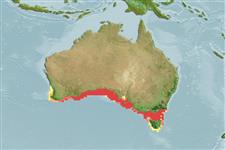
Southeastern Indian Ocean: Australia.
Tamaño / Peso / Edad
Madurez: Lm ? range ? - ? cm
Max length : 7.9 cm SL macho / no sexado; (Ref. 57438)
Descripción breve
Claves de identificación | Morfología | Morfometría
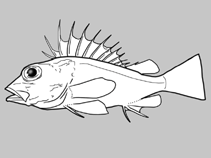
This species is characterized by the following: pectoral-fin rays 21-24 (22) ; scales in longitudinal series 47-51 (49); pored lateral-line scales 27-29 (28); scale rows between last pelvic-fin ray bases 3 or 4 (3); scales above lateral line 2 or 3 (3), below 12-14 (13); scales between sixth dorsal-fin spine base and lateral line 3-5 (4); scales between last dorsal-fin spine and lateral line 4 or 5 (5); scales above lateral line behind head usually with no strong median ridge; central portion of inner ridge on ventral mandibular surface at the inner edge of dentary or closer to inner edge than to central ridge, no short ridge between posterior
portions of inner and central ridges; spinous points 0-6 on anterior margin of nasal spine, number decreasing with growth, spinous points 5-15 on entire nasal spine; spinous points 5-13 on surface of preocular spine; spines or distinct ridges absent on lateral margin of occipital pit between tympanic spine and origin of parietal spine base; ossified scale behind front edge of occipital pit between tympanic spines absent; dorsal surface of occipital pit smooth, no spines; spinous points 2 (rarely 1 or 3) at tip of upper opercular spine; posterior margin of maxilla extending slightly beyond a vertical through posterior margin of pupil; snout length 7.9-9.6 (8.6)% SL, upper-jaw length 19.1-22.2 (20.3)% SL, first anal-fin spine length 11.6-14.4 (13.1)% SL, second anal-fin spine length 18.4-22.5 (20.5)% SL, third anal-fin spine length 13.4-16.2 (14.7)% SL, and caudal-peduncle depth 7.8-9.0 (8.6)% SL; body without reticulate color pattern; caudal fin of preserved specimens usually without distinct melanin (Ref. 57438).
Observed to bury itself completely in the sand during the day, but are fully exposed at night. Prefers deeper sand channels, away from rubble or seagrasses (Ref. 57438).
Ciclo vital y comportamiento de apareamiento
Madurez | Reproducción | Puesta | Huevos | Fecundidad | Larva
Motomura, H., P.R. Last and M.F. Gomon, 2006. A new species of the scorpionfish genus Maxillicosta from the Southeast coast of Australia, with a redescription of M. whitleyi (Scorpaeniformes: Neosebastidae). Copeia 2006(3):445-459. (Ref. 57438)
Situación en la Lista Roja de la UICN (Ref. 130435: Version 2025-2 (Global))
Amenaza para el ser humano
Harmless
Usos humanos
Herramientas
Informes especiales
Descargar XML
Fuentes de Internet
Estimaciones basadas en modelos
Temperatura preferida (Referencia
123201): 14.3 - 18.2, mean 16.7 °C (based on 124 cells).
Índice de diversidad filogenética (Referencia
82804): PD
50 = 0.5156 [Uniqueness, from 0.5 = low to 2.0 = high].
Bayesian length-weight: a=0.00389 (0.00180 - 0.00842), b=3.12 (2.94 - 3.30), in cm total length, based on all LWR estimates for this body shape (Ref.
93245).
Nivel trófico (Referencia
69278): 3.4 ±0.3 se; based on size and trophs of closest relatives
Vulnerabilidad pesquera (Ref.
59153): Low vulnerability (10 of 100).
🛈