>
Cyprinodontiformes (Rivulines, killifishes and live bearers) >
Aphaniidae (Oriental killifishes)
Etymology: Esmaeilius: Named for Hamid Reza Esmaeili (Shiraz) for his extensive contribution to the understanding of diversity within this genus; isfahanensis: Named for the province and its capital city, Isfahan, central Iran.
Eponymy: Dr Hamid Reza Esmaeili is an Iranian biologist and ichthyologist at Shiraz University, Shiraz where he is full Professor of Ichthyology. [...] (Ref. 128868), visit book page.
Lingkungan: lingkungan / zona iklim / kisaran kedalaman / jangkauan distribusi
Ekologi
; air tawar bentopelagis; kisaran kedalaman 0 - 1 m (Ref. 57741). Subtropical
Asia: Iran.
Ukuran / Berat / umur
Kematangan: Lm ? range ? - ? cm
Max length : 4.3 cm TL jantan/; (Ref. 94835); 3.8 cm SL (female)
deskripsi pendek
Kunci identifiaksi (pengenalan) | Morfologi | Morfometrik
duri punggung lunak (Keseluruhan (total)) : 10 - 13; Sirip dubur lunak: 10 - 12. This species is clearly distinguished at the genetic level from its congeners in having 82 molecular apomorphies-19 transversions, 2 transversions/transitions (depending on comparison), and 61 transitions - that show fixed character state differences to homologous characters analyzed in sophiae, persicus and vladykovi from Iran. Thirty-seven of these character states are also apomorphies when compared to anatoliae, danfordii, villwocki, asquamatus and fasciatus from Turkey (see www.cyprinodontiformes.org).
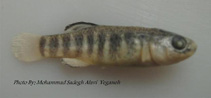
Males can be distinguished from all other Iranian species by having distinct black edge on the dorsal, anal, and pelvic fins; the dorsal fin is covered with a high density of black blotches (also observed in males of Aphanius anatoliae from Turkey).
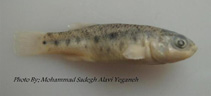
Females can be distinguished from those of sophiae and vladykovi by having flank-bars rather than spots; from persicus by less well-defined bars terminating at a mid-flank stripe and a relatively light gray stripe at the caudal-fin base rather than a black spot or blotch. However, flank-bars are also characteristic of females of dispar and fasciatus. Aphanius isfahanensis can be distinguished unambiguously only from vladykovi by a lower lateral-line scale count, but not with any morphometric or meristic character from sophiae or persicus (Ref. 57741).
Body shape (shape guide): fusiform / normal.
Collected from the lower reaches of the Zayanadeh River, 50 m width and 0.5 m depth, where water temperature is 27°C, pH 6.7, brackish water, conductivity 10.9 mS, dissolved solids 5450 ppm, dissolved oxygen 12.3 mg/L; current is slow and no cover (Ref. 57741).
Siklus hidup dan perilaku kawin
Kematangan | Reproduksi, perkembang biakan | Pemijahan | telur-telur | Fekunditas | Larva
Hrbek, T., Y. Keivany and B.W. Coad, 2006. New species of Aphanius (Teleostei, Cyprinodontidae) from Isfahan Province of Iran and a reanalysis of other Iranian species. Copeia 2006(2):244-255. (Ref. 57741)
Status IUCN Red List (Ref. 130435: Version 2025-2 (Global))
ancaman kepada manusia
Harmless
penggunaan manusia
Alat, peralatan
laporan khas
muat turun XML
Sumber internet
Estimasi berdasarkan model
Indeks keanekaragaman filogenetik (Acuan
82804): PD
50 = 0.5156 [Uniqueness, from 0.5 = low to 2.0 = high].
Bayesian length-weight: a=0.00912 (0.00688 - 0.01208), b=3.22 (3.18 - 3.26), in cm total length, based on LWR estimates for this species (Ref.
93245).
Tingkat Trofik (Acuan
69278): 3.0 ±0.4 se; based on size and trophs of closest relatives
Daya lenting (Acuan
120179): Tinggi, Waktu penggandaan populasi minimum kurang dari 15 bulan (Preliminary K or Fecundity.).
Kerentanan Penangkapan Ikan (Ref.
59153): Low vulnerability (10 of 100).
🛈