Clasificación / Nombres
Nombres comunes | Sinónimos | Catalog of Fishes(Género, Especie) | ITIS | CoL | WoRMS | Cloffa
>
Pleuronectiformes (Flatfishes) >
Soleidae (Soles)
Etymology: Aseraggodes: Greek, aggos, -eos, -ous = vessel, uterus, carapace of a crab + Greek, aseros, -a, -on = to remove the appetite (Ref. 45335); heemstrai: Named for Phillip Heemstra.
Eponymy: Dr Phillip Clarence Heemstra (1941–2019) was an American/South African marine ichthyologist and scientific diver. [...] (Ref. 128868), visit book page.
More on authors: Randall & Gon.
Entorno: milieu / zona climática / rango de profundidad / gama de distribución
Ecología
marino asociado a arrecife; rango de profundidad 15 - 39 m (Ref. 57561). Tropical; 27°S - 31°S (Ref. 57561)
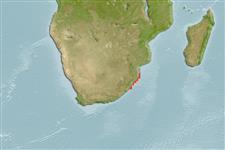
Western Indian Ocean: South Africa.
Tamaño / Peso / Edad
Madurez: Lm ? range ? - ? cm
Max length : 8.7 cm SL macho / no sexado; (Ref. 57561)
Descripción breve
Claves de identificación | Morfología | Morfometría
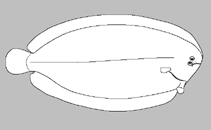
Radios blandos dorsales (total) : 68 - 75; Radios blandos anales: 48 - 52; Vértebra: 36 - 38. DIAGNOSIS: Dorsal rays 68-75; anal rays 48-52; dorsal and anal rays branched except for a few anterior rays; lateral-line scales 70-78, including 9 or 10 anterior to a vertical at upper
end of gill opening; lateral line on ocular side projecting toward dorsal part of upper
eye; vertebrae 36-38; dorsal pterygiophores anterior to fourth neural spine 11-13; body
depth 2.4-2.45 in SL; head length (HL) 4.05-4.35 in SL; snout length 2.65-2.95 in HL; eye diameter 4.6-5.05 in HL; interorbital space very narrow, the least vertical width 26-33 in HL; tubular anterior nostril nearly reaching eyeball when laid back; cirri on front of snout and ventral side of head small and slender; no cirri on opercle at edge of gill opening, and none along edge of membranous ridges of dorsal and anal rays; caudal peduncle present but very short, the length 10.2-17.7 in HL; caudal-peduncle depth 1.7-1.95 in HL; longest dorsal ray 1.65-1.8
in HL; caudal-fin length 4.2-4.7 in SL; pelvic-fin length 1.75-2.0 in HL, reaching base third anal ray; color of ocular side when fresh brown, the edges of scales darker brown, with numerous irregular dark-edged white spots, the largest (most smaller than eye) in three rows, one below dorsal .n, one above anal .n, and one along lateral line, where most irregular; scattered small blackish spots, some specimens with indistinct larger blackish blotches alternating with large white spots of the three rows; fin rays with small brown and larger white spots, the membranes translucent. Color in alcohol with white spots, faint to absent and dark spots subdued (Ref. 57561).
Body shape (shape guide): short and / or deep.
Ciclo vital y comportamiento de apareamiento
Madurez | Reproducción | Puesta | Huevos | Fecundidad | Larva
Randall, J.E. and O. Gon, 2006. Review of the soles of the genus Aseraggodes of the Western Indian Ocean, with descrtiptions of three new species. Israel J. Zool. 51:165-190. (Ref. 57561)
Situación en la Lista Roja de la UICN (Ref. 130435: Version 2025-2 (Global))
Amenaza para el ser humano
Harmless
Usos humanos
Herramientas
Informes especiales
Descargar XML
Fuentes de Internet
Estimaciones basadas en modelos
Temperatura preferida (Referencia
123201): 22.5 - 24.3, mean 23.9 °C (based on 8 cells).
Índice de diversidad filogenética (Referencia
82804): PD
50 = 0.5000 [Uniqueness, from 0.5 = low to 2.0 = high].
Bayesian length-weight: a=0.00955 (0.00454 - 0.02011), b=3.07 (2.90 - 3.24), in cm total length, based on LWR estimates for this (Sub)family-body shape (Ref.
93245).
Nivel trófico (Referencia
69278): 3.5 ±0.5 se; based on size and trophs of closest relatives
Resiliencia (Referencia
120179): Alto, población duplicada en un tiempo mínimo inferior a 15 meses (Preliminary K or Fecundity.).
Vulnerabilidad pesquera (Ref.
59153): Low vulnerability (10 of 100).
🛈