Klassifizierung / Names
Namen | Synonyme | Catalog of Fishes(Gattung, Arten) | ITIS | CoL | WoRMS | Cloffa
>
Eupercaria/misc (Various families in series Eupercaria) >
Sparidae (Porgies)
Etymology: Acanthopagrus: Greek, akantha = thorn + Greek, pagros, a kind of fish (Ref. 45335).
Umwelt: Milieu / Klimazone / Tiefenbereich / Verbreitungsgebiet
Ökologie
seewasser demersal. Temperate
Verbreitung
Territorien | FAO Gebiete | Ökosysteme | Vorkommen | Punkt Karte | Einführungen | Faunafri
Northwest Pacific: Taiwan.
Größe / Gewicht / Alter
Geschlechtsreife: Lm ? range ? - ? cm
Max length : 18.4 cm SL Männchen/unbestimmt; (Ref. 57874); 21.6 cm SL (female)
Kurzbeschreibung
Bestimmungsschlüssel | Morphologie | Morphometrie
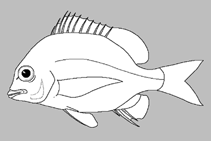
Rückenflossenstacheln (insgesamt) : 11; Rückenflossenweichstrahlen (insgesamt) : 10 - 12; Afterflossenstacheln: 3; Afterflossenweichstrahlen: 8 - 9. This species is distinguished by the following characters: D XI-XII, 10-12; A III, 8-9; scale rows between the fifth dorsal-fin spine base and lateral line 3.5; cheek scale rows 3-4; body rounded; ventral infraorbital series above posterior part of upper jaw changing with growth from almost straight to weakly concave; second anal-fin spine robust and dull pointed; upper and lower jaws with thin lips,
especially anteriorly; broadly rounded rostral-most head squamation with ca. 10 somewhat smaller scales anteriorly; with growth, prominent ridge developing just before eye and dorsal head profile becoming slightly convex from snout to just above eye; upper and lower molar teeth strongly developed and
flattened on both sides, gradually more molariform posteriorly; upper molars in 3 or 4 rows anteriorly and 4 or 5 posteriorly, rows generally irregular, outer third row distinctly larger; lower molars in 3 or 4 rows anteriorly and 2 or 3 rows posteriorly, rows generally irregular, with innermost row largest posteriorly (outer second row gently curved outward); colour of head and body mostly black, sharply demarcated from whitish belly and chin; a dark spot at top of pectoral-fin base (Ref. 57874).
Body shape (shape guide): short and / or deep; Cross section: compressed.
Lebenszyklus und Paarungsverhalten
Geschlechtsreife | Fortpflanzung | Ablaichen | Eier | Fruchtbarkeit | Larven
Iwatsuki, Y. and K. Carpenter, 2006. Acanthopagrus taiwanensis, a new sparid fish (Perciformes), with comparisons to Acanthopagrus berda (Forsskål, 1775) and other nominal species of Acanthopagrus. Zootaxa 1202:1-19. (Ref. 57874)
IUCN Rote Liste Status (Ref. 130435: Version 2025-2 (Global))
Bedrohung für Menschen
Harmless
Nutzung durch Menschen
Fischereien: kommerziell
Tools
Zusatzinformationen
Download XML
Internet Quellen
Schätzungen auf der Grundlage von Modellen
Phylogenetischer Diversitätsindex (Ref.
82804): PD
50 = 0.5000 [Uniqueness, from 0.5 = low to 2.0 = high].
Bayesian length-weight: a=0.01995 (0.00886 - 0.04496), b=2.97 (2.80 - 3.14), in cm total length, based on LWR estimates for this Genus-body shape (Ref.
93245).
Trophische Ebene (Ref.
69278): 3.3 ±0.4 se; based on size and trophs of closest relatives
Widerstandsfähigkeit (Ref.
120179): mittel, Verdopplung der Population dauert 1,4 - 4,4 Jahre. (Preliminary K or Fecundity.).
Anfälligkeit der Fischerei (Ref.
59153): Low vulnerability (16 of 100).
🛈