Окружающая среда: среда / климатическая зона / пределы глубины / диапазон распространения
экология
; пресноводный демерсальный. Temperate; 49°N - 43°N, 3°E - 9°E
Europe: Rhône drainage, except Lake Geneva basin (France, Switzerland). Originaly widespread, but following habitat alterations, distribution is now much fragmented and restricted. Main subsisting populations in the middle Doubs (France, Switzerland) and Durance and Ardeche (southern France).
Размер / Вес / Возраст
половая зрелость: Lm ? range ? - ? cm
Max length : 22.0 cm TL самец/пол неопределен; (Ref. 556); наибольший вес (опубликованные данные): 100.00 g (Ref. 30578)
Краткое описание
определительные ключи | морфология | морфометрия
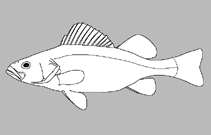
колючие лучи спинного плавника (общее число) : 8 - 13; членистые (мягкие) лучи спинного плавника (общее число) : 10 - 14; колючие лучи анального плавника: 1 - 3; членистые (мягкие) лучи анального плавника: 8 - 12; позвонки: 43 - 45. The presence of 57-65 + 3-6 scales along lateral line distinguishes uniquely this species from its congeners. Can be further separated from other species by the combination of the following characters: first dorsal fin with 8-9 spines; second dorsal fin with 1-2 simple and 9-12½ branched rays; scaleless cheeks (Ref. 59043). Caudal fin with 17 soft rays (Ref. 40476).
Body shape (shape guide): elongated.
A short-lived species reported to live in fast-flowing rivers with a gravel substrate (Ref. 30578). Occurs in main course of rivers and large streams and in riffles. Found on stone bottom (Ref. 59043). Lurks on the bottom during the day and comes out for crepuscular feeding (Ref. 11941). Feeds on aquatic invertebrates. Larvae feed on plankton under surface, then at about 2.5 cm SL, they move to benthic habitats. Attains first sexual maturity at 2-4 years of age. Spawns in deeper parts of riffles. Deposits on gravel strongly adhesive eggs, 2.2 mm in diameter, which hatch in about 14 days at 13° C (Ref. 59043). Threatened due to habitat destruction and pollution (Ref. 26100).
Жизненный цикл и брачное поведение
половая зрелость | размножение | нерест | икра | Плодовитость | личинки
Probably spawns as Zingel streber over gravel.
Kottelat, M. and J. Freyhof, 2007. Handbook of European freshwater fishes. Publications Kottelat, Cornol and Freyhof, Berlin. 646 pp. (Ref. 59043)
Статус Красного Списка МСОП (Ref. 130435: Version 2025-2 (Global))
Угроза для людей
Harmless
Использование человеком
рыболовство: интереса не представляет
дополнительная информация
инструменты
Специальные отчеты
Скачать в формате XML
ресурсы в Интернет
Оценки, основанные на моделях
Индекс филогенетического разнообразия (ссылка
82804): PD
50 = 0.5625 [Uniqueness, from 0.5 = low to 2.0 = high].
Bayesian length-weight: a=0.00457 (0.00223 - 0.00937), b=3.11 (2.92 - 3.30), in cm total length, based on LWR estimates for this (Sub)family-body shape (Ref.
93245).
Трофический уровень (ссылка
69278): 3.3 ±0.37 se; based on food items.
устойчивость к внешним воздействиям (ссылка
120179): средний (среднего размера), минимальное время удвоения популяции 1.4-4.4 года (Preliminary K or Fecundity.).
Уязвимость рыбной ловли (Ref.
59153): Low vulnerability (12 of 100).
🛈