>
Ophidiiformes (Cusk eels) >
Dinematichthyidae (Viviparous brotula)
Etymology: Diancistrus: Greek, di = two + Greek, agkistron = hook (Ref. 45335); karinae: Named for Karin Bloch, wife of Jørgen Nielsen.
Eponymy: Karin Bloch is the wife of the third author, Jørgen Nielsen, who thanked her for her “most valuable support” during the many hours he invested in the study of this genus. (Ref. 128868), visit book page.
More on authors: Schwarzhans, Møller & Nielsen.
Ambiente: milieu / zona climatica / distribuzione batimetrica / gamma di distribuzione
Ecologia
marino benthopelagico; distribuzione batimetrica 0 - 16 m (Ref. 57884). Tropical
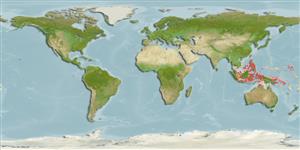
Western Central Pacific: from the Philippines to the northern tip of Sulawesi (Indonesia) in the west and the oceanic islands of Palau, Pohnpei (Micronesia) and Hermit (PNG) islands in the east.
Dimensione / Peso / Età
Maturità: Lm ? range ? - ? cm
Max length : 7.5 cm SL maschio/sesso non determinato; (Ref. 57884); 8.2 cm SL (female)
Breve descrizione
Chiavi di identificazione | Morfologia | Morfometria
Raggi dorsali molli (totale) : 78 - 83; Raggi anali molli: 61 - 68; Vertebre: 43 - 46. This species is characterized by the following: Vertebrae 11-12+32-35=43-46, dorsal fin rays 78-83, anal fin rays 61-68; very large eyes (2.7-3.8% SL), D/V 7; outer pseudoclasper large, about 1 1/2 length of inner pseudoclasper, wing-shaped, flat and its posterior part strongly bent backward; inner pseudoclasper joined to outer pseudoclasper anteriorly, long, single-pointed tip strongly extending over anterior part of inner pseudoclasper; scale patch on cheek with 5-6 scale rows on upper cheek, large scale patch on operculum continuous above and below opercular spine; head high, usually high-necked; otolith length to height ratio 2.0-2.1 (Ref. 57884).
Body shape (shape guide): elongated; Cross section: compressed.
Solitary inhabitant of coral reef crevices to at least 16 m depth, cryptic (Ref 90102).
Ciclo vitale e comportamento di accoppiamento
Maturità | Riproduzione | Deposizione | Uova | Fecondità | Larve
Schwarzhans, W., P.R. Møller and J.G. Nielsen, 2005. Review of the Dinematichthyini (Teleostei, Bythitidae) of the Indo-West-Pacific. Part I. Diancistrus and two new genera with 26 new species. The Beagle, Records of the Museum and Art Galleries of the Northern Territory 21:73-163. (Ref. 57884)
Stato della Lista Rossa IUCN (Ref. 130435: Version 2025-2 (Global))
Minaccia per l'uomo
Harmless
Usi umani
Pesca: di nessun interesse
Strumenti
Rapporti speciali
Scarica XML
Fonti Internet
Stime basate su modelli
Temperatura preferita (Fonte Biblio.
123201): 28.4 - 29.3, mean 28.9 °C (based on 944 cells).
Indice di diversità filogenetica (Fonte Biblio.
82804): PD
50 = 0.5000 [Uniqueness, from 0.5 = low to 2.0 = high].
Bayesian length-weight: a=0.00389 (0.00180 - 0.00842), b=3.12 (2.94 - 3.30), in cm total length, based on all LWR estimates for this body shape (Ref.
93245).
Livello trofico (Fonte Biblio.
69278): 3.3 ±0.5 se; based on size and trophs of closest relatives
Vulnerabilità della pesca (Ref.
59153): Low vulnerability (10 of 100).
🛈