>
Ophidiiformes (Cusk eels) >
Dinematichthyidae (Viviparous brotula)
Etymology: Dermatopsis: Greek, derma = skin + Greek, opsis = appearance (Ref. 45335); hoesei: Named for Doug Hoese, Australian Museum, Sydney.
Eponymy: Dr Douglass Fielding ‘Doug’ Hoese (d: 1942) is Senior Fellow, Ichthyology Collection, Australian Museum, Sydney. [...] (Ref. 128868), visit book page.
More on authors: Møller & Schwarzhans.
Environnement : milieu / zone climatique / profondeur / gamme de distribution
Écologie
marin récifal; profondeur 0 - 4 m (Ref. 57886). Subtropical; 29°S - 37°S (Ref. 57886)
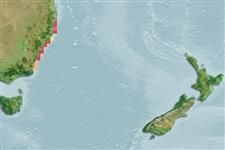
Western Pacific: SE Australia, south of the Great Barrier Reef, chiefly along the shores of New South Wales.
Taille / Poids / Âge
Maturité: Lm ? range ? - ? cm
Max length : 4.0 cm SL mâle / non sexé; (Ref. 57886); 4.8 cm SL (female)
Description synthétique
Clés d'identification | Morphologie | Morphométrie
Rayons mous dorsaux (Total) : 67 - 77; Rayons mous anaux: 46 - 53; Vertèbres: 40 - 43. The species is characterized by the following: vertebrae 11-14 + 27-31 = 40-43, dorsal fin rays 67-77, anal fin rays 46-53; no scales on the head and body; posterior nostril large, about half size of eye; lower preopercular pore large, about size of posterior nostril or larger; weak spine on maxilla positioned behind rear tip of eye; single pair of pseudoclaspers curved, expanded and paddle-like, longer than penis, without fleshy appendices; otolith with pointed posterior tip and concavity above and massive postdorsal angle, otolith length to height ratio 1.9-2.0, sulcus with divided colliculi (Ref. 57886).
Body shape (shape guide): elongated.
Occurs along rocky shores at shallow depths. A female specimen (AMS 15330-037, 42 mm SL), contained 3 embryos, 11-16 mm SL. The species is pale except for some weak pigmentation on top of head (Ref. 57886).
Cycle de vie et comportement reproducteur
Maturité | Reproduction | Frai | Œufs | Fécondité | Larves
Møller, P.R. and W. Schwarzhans, 2006. Review of the Dinematichthyini (Teleostei, Bythitidae) of the Indo-west Pacific, Part II. Dermatopsis, Dermatopsoides and Dipulus with description of six new species. The Beagle 22:39-76. (Ref. 57886)
Statut dans la liste rouge de l'IUCN (Ref. 130435: Version 2025-2 (Global))
Menace pour l'homme
Harmless
Utilisations par l'homme
Outils
Articles particuliers
Télécharger en XML
Sources Internet
Estimations basées sur des modèles
Température préférée (Réf.
123201): 20 - 23.3, mean 21.8 °C (based on 15 cells).
Indice de diversité phylogénétique (Réf.
82804): PD
50 = 0.5312 [Uniqueness, from 0.5 = low to 2.0 = high].
Bayesian length-weight: a=0.00389 (0.00180 - 0.00842), b=3.12 (2.94 - 3.30), in cm total length, based on all LWR estimates for this body shape (Ref.
93245).
Niveau trophique (Réf.
69278): 3.2 ±0.5 se; based on size and trophs of closest relatives
Vulnérabilité de la pêche (Ref.
59153): Low vulnerability (10 of 100).
🛈