>
Ophidiiformes (Cusk eels) >
Dinematichthyidae (Viviparous brotula)
Etymology: Ogilbia: Taken from Ogilby, 1887-1915, icthiologist and zoologist (Ref. 45335); suarezae: Named for Dr. Susan S. Suarez, Cornell University.
Eponymy: James Douglas Ogilby (1853–1925) was an Irish-born Australian ichthyologist and taxonomist, son of the famous zoologist William Ogilby (below). [...] Dr Susan Stevens Suarez (d: 1949) is Professor Emeritus (2017) of Biomedical Sciences, College of Veterinary Medicine, Cornell University. [...] (Ref. 128868), visit book page.
More on authors: Møller, Schwarzhans & Nielsen.
Environnement : milieu / zone climatique / profondeur / gamme de distribution
Écologie
marin récifal; profondeur 0 - 10 m (Ref. 57883). Tropical
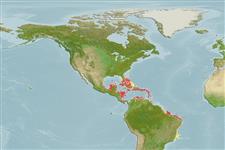
Western Atlantic: widely distributed from the Gulf of Mexico and the Caribbean Sea. Appears to have a disjunct distribution: southernmost tip of the Yucatan Peninsula to Belize along the shores of Central America to Panama, and from off southernmost Florida to Haiti, Puerto Rico, Bahamas and the Antilles as far south as Dominica; so far, not known off Cuba, the Cayman Islands, Venezuela or Trinidad and Tobago.
Taille / Poids / Âge
Maturité: Lm ? range ? - ? cm
Max length : 7.5 cm SL mâle / non sexé; (Ref. 57883)
Description synthétique
Clés d'identification | Morphologie | Morphométrie
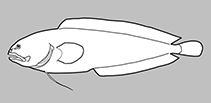
Rayons mous dorsaux (Total) : 66 - 82; Rayons mous anaux: 48 - 63; Vertèbres: 39 - 44. This species is distinguished by the following: Vertebrae 11-12 + 28-33 = 39-44, dorsal fin rays 66-82, anal fin rays 48-63; outer pseudoclasper a small triangular flap; inner pseudoclasper as long as or longer than the outer pseudoclasper, with narrow base and broad tip, penis tapering; opercular spine with single, sharp tip; scale patch on cheeks with 5-7 vertical scale rows; otolith length: height ratio 2.0-2.1, sulcus axis slightly inclined against otolith axis (Ref. 57883).
Inhabits rocky and coral reefs. A 44 mm SL female specimen (USNM 347360) contained 75 embryos, 5 mm TL, with about 8 small spots along dorsal fin base and about 6 elongate marks midlaterally; no eggs (Ref. 57883).
Cycle de vie et comportement reproducteur
Maturité | Reproduction | Frai | Œufs | Fécondité | Larves
Møller, P.R., W. Schwarzhans and J.G. Nielsen, 2005. Review of the American Dinematichthyini (Teleostei: Bythitidae). Part II. Ogilbia. aqua, J. Ichthyol. Aquat. Biol. 10(4):133-207. (Ref. 57883)
Statut dans la liste rouge de l'IUCN (Ref. 130435: Version 2025-2 (Global))
Menace pour l'homme
Harmless
Utilisations par l'homme
Outils
Articles particuliers
Télécharger en XML
Sources Internet
Estimations basées sur des modèles
Température préférée (Réf.
123201): 26.4 - 28.2, mean 27.4 °C (based on 469 cells).
Indice de diversité phylogénétique (Réf.
82804): PD
50 = 0.5000 [Uniqueness, from 0.5 = low to 2.0 = high].
Bayesian length-weight: a=0.00389 (0.00180 - 0.00842), b=3.12 (2.94 - 3.30), in cm total length, based on all LWR estimates for this body shape (Ref.
93245).
Niveau trophique (Réf.
69278): 3.3 ±0.5 se; based on size and trophs of closest relatives
Vulnérabilité de la pêche (Ref.
59153): Low vulnerability (10 of 100).
🛈