Classification / Noms
Noms communs | Synonymes | Catalog of Fishes(Genre, Espèce) | ITIS | CoL | WoRMS | Cloffa
Environnement : milieu / zone climatique / profondeur / gamme de distribution
Écologie
; eau douce démersal. Subtropical
Asia: Turkey.
Taille / Poids / Âge
Maturité: Lm ? range ? - ? cm
Max length : 7.6 cm TL mâle / non sexé; (Ref. 125966); poids max. publié: 3.39 g (Ref. 125966)
Description synthétique
Clés d'identification | Morphologie | Morphométrie
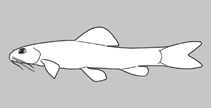
This species is distinguished from other species of the O. angorae group by the following characters: with deeply emarginate caudal fin in which the shortest middle caudal-fin ray is 65-76% of the longest ray of the upper caudal-fin lobe (vs. moderately emarginate to almost truncate, 84-93 in O. anatolicus, 88-92 in O. angorae, 83-91 in O. eregliensis; 72-82 in O. O. germencicus, and 71-85 in O. isauricus); body depth slightly decreasing or almost uniform between the dorsal- and caudal-fin base, depth of caudal peduncle 85-92% of body depth at anterior-most dorsal fin base (vs. 68-79 in O. anatolicus, 70-83 in O. angorae and O. eregliensis, 72-82 in O. germencicus, 60-77 in O. isauricus), elongated blotches on flank being usually connected to the saddles on the back, meeting contralateral on flank (vs. usually disconnected), caudal peduncle depth 1.2-1.5 times in its length (vs. 1.5-1.8 in O. angorae and O. germencicus, 1.5-1.9 in O. eregliensis, 2.2-2.6 in O. isauricus); differs from O. anatolicus by having a narrower interorbital distance. 26-35% HL (vs. 33-40) and from O. angorae by lacking a depigmented stripe along the anterior part of the lateral line (vs. usually present) (Ref. 131061).
Cross section: oval.
Cycle de vie et comportement reproducteur
Maturité | Reproduction | Frai | Œufs | Fécondité | Larves
Erk'akan, F., T.T. Nalbant and S.C. Özeren, 2007. Seven new species of Barbatula, three new species of Schistura and a new species of Seminemacheilus (Ostariophysi: Balitoridae: Nemacheilinae) from Turkey. J. Fish. Intl. 2(1):69-85. (Ref. 57968)
Statut dans la liste rouge de l'IUCN (Ref. 130435: Version 2025-2 (Global))
Menace pour l'homme
Harmless
Utilisations par l'homme
Pêcheries: sans intérêt
Outils
Articles particuliers
Télécharger en XML
Sources Internet
Estimations basées sur des modèles
Indice de diversité phylogénétique (Réf.
82804): PD
50 = 0.5000 [Uniqueness, from 0.5 = low to 2.0 = high].
Bayesian length-weight: a=0.00759 (0.00430 - 0.01340), b=3.01 (2.86 - 3.16), in cm total length, based on LWR estimates for this species & Genus-body shape (Ref.
93245).
Niveau trophique (Réf.
69278): 2.8 ±0.3 se; based on size and trophs of closest relatives
Résilience (Réf.
120179): Milieu, temps minimum de doublement de population : 1,4 à 4,4 années (Preliminary K or Fecundity.).
Vulnérabilité de la pêche (Ref.
59153): Low vulnerability (10 of 100).
🛈