>
Clupeiformes (Herrings) >
Engraulidae (Anchovies) > Coiliinae
Etymology: Coilia: Greek, koilia, -as = abdomen, hollow (Ref. 45335).
Eponymy: Johann Heinrich Andreaus Bernhard Sonnemann Rebentisch was a Dutch military health officer (he was Surgeon Colonel in Sinkawang, a city in Indonesian Borneo) who collected (1858–1859) specimens of fish for Bleeker, including the holotype of this [...] (Ref. 128868), visit book page.
More on author: Bleeker.
Entorno: milieu / zona climática / rango de profundidad / gama de distribución
Ecología
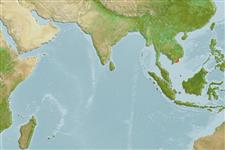
marino; salobre pelagic-neritic; rango de profundidad 0 - 50 m (Ref. 189). Tropical; 14°N - 1°N, 106°E - 111°E (Ref. 189)
Western Central Pacific: Indonesia (western coast of Kalimantan), Malaysia, Brunei, and Viet Nam (Saigon).
Tamaño / Peso / Edad
Madurez: Lm ? range ? - ? cm
Max length : 15.2 cm SL macho / no sexado; (Ref. 189)
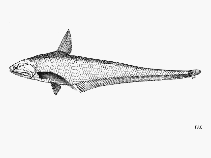
Espinas dorsales (total) : 0; Espinas anales: 0; Radios blandos anales: 80. Body tapering, belly rounded in front of pelvic fins, with at most 1 + 10 to 12 = 11 to 13 keeled scutes from just before pelvic fin base to anus. Maxilla short, not reaching beyond edge of gill cover. Pectoral fin with 16 to 19 long filaments and 7 to 10 branched fin rays, much shorter than those of pelvic fin.
Body shape (shape guide): elongated; Cross section: compressed.
Occurs in coastal waters and estuaries, but the extent of its movements into the sea or up rivers is not known. Scarce in museum collections but this may not reflect its actual abundance.
Ciclo vital y comportamiento de apareamiento
Madurez | Reproducción | Puesta | Huevos | Fecundidad | Larva
Spawn in school (Ref. 205).
Wongratana, T., T.A. Munroe and M. Nizinski, 1999. Order Clupeiformes. Engraulidae. Anchovies. p. 1698-1753. In K.E. Carpenter and V.H. Niem (eds.) FAO species identification guide for fishery purposes. The living marine resources of the WCP. Vol. 3. Batoid fishes, chimaeras and bony fishes part 1 (Elopidae to Linophrynidae). FAO, Rome. (Ref. 9822)
Situación en la Lista Roja de la UICN (Ref. 130435: Version 2025-2 (Global))
Amenaza para el ser humano
Harmless
Usos humanos
Pesquerías: pesquerías de subsistencia
Herramientas
Informes especiales
Descargar XML
Fuentes de Internet
Estimaciones basadas en modelos
Índice de diversidad filogenética (Referencia
82804): PD
50 = 0.5001 [Uniqueness, from 0.5 = low to 2.0 = high].
Bayesian length-weight: a=0.00282 (0.00123 - 0.00644), b=3.10 (2.92 - 3.28), in cm total length, based on LWR estimates for this Genus-body shape (Ref.
93245).
Nivel trófico (Referencia
69278): 3.3 ±0.4 se; based on size and trophs of closest relatives
Resiliencia (Referencia
120179): Alto, población duplicada en un tiempo mínimo inferior a 15 meses (Preliminary K or Fecundity.).
Vulnerabilidad pesquera (Ref.
59153): Low vulnerability (10 of 100).
🛈