Ikan bertulang rawan (sharks and rays) >
Myliobatiformes (Stingrays) >
Dasyatidae (Stingrays) > Hypolophinae
Etymology: Pastinachus: Latin, pastinaca = a sting ray (Ref. 45335); solocirostris: Name from Latin 'solocis' meaning rough or bristly and 'rostrum' for snout, referring to the unusually rough texture of the snout.
More on authors: Last, Manjaji & Yearsley.
Lingkungan: lingkungan / zona iklim / kisaran kedalaman / jangkauan distribusi
Ekologi
laut; payau dasar (demersal). Tropical
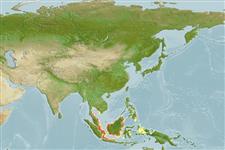
Western Pacific: Malaysian Borneo and Indonesia.
Panjang pada saat jatuh tempo pertama / Ukuran / Berat / umur
Kematangan: Lm 32.0, range 28 - 36 cm
Max length : 45.0 cm WD jantan/; (Ref. 58048); 44.6 cm WD (female)
deskripsi pendek
Kunci identifiaksi (pengenalan) | Morfologi | Morfometrik
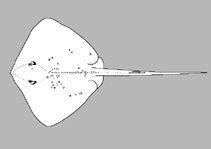
A small species with the following diagnostic characters: acute snout, angle less than 110°, covered to apex with enlarged denticles; disc length 94-101% WD; head length 47-51% WD; preoral length 21-25% WD; distance between nostrils 9-11% WD; distance between first gill slits 20-25% WD; tail moderately compressed above the midbase of the ventral cutaneous fold, width 0.7-0.9 times its height; ventral fold slender, its length 1.1-1.3 times WD, 32-41 times its depth below its midbase; ventral fold depth 1.8-2.4 times tail height at its midbase; distance from cloaca to sting 0.9-1 in precloacal length; 1-3 nuchal thorns, largest pearl-shaped; pectoral fin radials 113-120; monospondylous vertebral centra 35-38 (Ref. 58027).
Body shape (shape guide): other.
Found most abundant near the coast in regions of high riverine outflow. Largest immature male was found to be 27.5 cm WD. No data on size at birth, with smallest specimen 13.2 cm WD of a late male embryo (Ref. 58027). Data for Max.Length of female from Ref.58027. Caught occasionally by bottom trawl and demersal gillnet fisheries operating off Sumatra and Kalimantan. Utilized for its meat and probably its skin (Ref.58048).
Siklus hidup dan perilaku kawin
Kematangan | Reproduksi, perkembang biakan | Pemijahan | telur-telur | Fekunditas | Larva
Last, P.R., B.M. Manjaji and G.K. Yearsley, 2005. Pastinachus solocirostris sp. nov., a new species of stingray (Elasmobranchii: Myliobatiformes) from the Indo-Malay Archipelago. Zootaxa 1040:1-16. (Ref. 58027)
Status IUCN Red List (Ref. 130435: Version 2025-2 (Global))
ancaman kepada manusia
Harmless
penggunaan manusia
Alat, peralatan
laporan khas
muat turun XML
Sumber internet
Estimasi berdasarkan model
Suhu yang disukai (Acuan
123201): 28.2 - 29.1, mean 28.7 °C (based on 172 cells).
Indeks keanekaragaman filogenetik (Acuan
82804): PD
50 = 0.5312 [Uniqueness, from 0.5 = low to 2.0 = high].
Bayesian length-weight: a=0.01000 (0.00244 - 0.04107), b=3.04 (2.81 - 3.27), in cm total length, based on all LWR estimates for this body shape (Ref.
93245).
Tingkat Trofik (Acuan
69278): 3.7 ±0.6 se; based on size and trophs of closest relatives
Kerentanan Penangkapan Ikan (Ref.
59153): Very high vulnerability (90 of 100).
🛈