Élasmobranches (requins et raies) (sharks and rays) >
Rhinopristiformes (Shovelnose rays) >
Rhinobatidae (Guitarfishes)
Etymology: Rhinobatos: Greek, rhinos = nose + Greek, batis, -idos = a ray (Raja sp.) (Ref. 45335); nudidorsalis: Name from Latin 'nudus' meaning bare or naked and 'dorsum' for back, referring to its smooth, denticle-free upper surface.
More on authors: Last, Compagno & Nakaya.
Environnement : milieu / zone climatique / profondeur / gamme de distribution
Écologie
marin démersal; profondeur ? - 125 m (Ref. 55722). Tropical
Central Indian Ocean: Mascarene Ridge. High Seas only.
Taille / Poids / Âge
Maturité: Lm ? range ? - ? cm
Max length : 50.1 cm TL mâle / non sexé; (Ref. 55722)
Description synthétique
Clés d'identification | Morphologie | Morphométrie
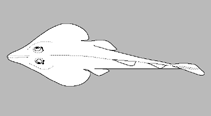
This species is distinguished by the following characters: no thorns on upper surface of the disc, with tail and unpaired fins almost entirely naked; a small, elongate to oval-shaped denticle patch across a naked upper caudal peduncle and upper caudal-fin lobe; a wedge-shaped disc; moderately large orbit, exceeding 4% total length (TL); oblique nostrils, length 1.7 times internarial distance; anterior nasal flaps penetrating well into internarial space, but not almost united; posterior nasal flaps broad; ridges of rostral cartilages well separated dorsally and almost parallel; prebranchial sensory pore patch narrow, extending to first gill slit; postscapular sensory canal long with lateral pores, not grooved, extending almost to pectoral-fin insertions; low dorsal fins; pelvic-fin inner margin distinctly longer than its base; interdorsal distance less than 2.5 times first dorsal-fin base; 2 spiracular folds, outer is much larger than the inner one; caudal fin small with dorsal margin about 1.8 times preventral margin; 172 total vertebral centra; dorsal disc plain colored (Ref. 55722).
Body shape (shape guide): elongated.
Offshore on insular shelves of the Central Indian Ocean, distribution probably restricted (Ref. 114953). Maximum size is actually unknown, presumably a small- to moderate-size species given that the half-meter holotype is sexually mature (Ref. 55722). Biology is unknown, more specimens needed (Ref. 114953).
Cycle de vie et comportement reproducteur
Maturité | Reproduction | Frai | Œufs | Fécondité | Larves
Last, P.R., L.J.V. Compagno and K. Nakaya, 2004. Rhinobatos nudidorsalis, a new species of shovelnose ray (Batoidea: Rhinobatidae) from the Mascarene Ridge, central Indian Ocean. Ichthyol. Res. 51:153-158. (Ref. 55722)
Statut dans la liste rouge de l'IUCN (Ref. 130435: Version 2025-2 (Global))
Menace pour l'homme
Harmless
Utilisations par l'homme
Outils
Articles particuliers
Télécharger en XML
Sources Internet
Estimations basées sur des modèles
Indice de diversité phylogénétique (Réf.
82804): PD
50 = 0.5000 [Uniqueness, from 0.5 = low to 2.0 = high].
Bayesian length-weight: a=0.00295 (0.00150 - 0.00581), b=3.13 (2.96 - 3.30), in cm total length, based on LWR estimates for this (Sub)family-body shape (Ref.
93245).
Niveau trophique (Réf.
69278): 3.6 ±0.4 se; based on size and trophs of closest relatives
Résilience (Réf.
120179): Faible, temps minimum de doublement de population : 4,5 à 14 années (Preliminary low fecundity).
Vulnérabilité de la pêche (Ref.
59153): Moderate vulnerability (40 of 100).
🛈