أشلاق (القروش و الشفانين) (sharks and rays) >
Orectolobiformes (Carpet sharks) >
Orectolobidae (Carpet or nurse sharks)
Etymology: Orectolobus: orektos (Gr.), stretched out; lobus (L.), from lobos (Gr.), rounded projection or protuberance, referring to long nasal barbels of Squalus barbatus (=O. maculatus) (See ETYFish); hutchinsi: In honor of J. Barry Hutchins (b. 1946), Curator of Fishes, Western Australian Museum (Perth), who first reported this shark as a new species in 1983 (See ETYFish).
Eponymy: Dr J Barry Hutchins (d: 1946) was Curator of Fishes at the Western Australian Museum (1998–2007), which he joined as a Technical Officer (1972) and where he worked until he retired. [...] (Ref. 128868), visit book page.
More on authors: Last, Chidlow & Compagno.
البيئة: الوسط / المنطقة المناخية / نطاق العمق / نطاق التوزيع
البيئة
بحري القاع; نطاق العمق 0 - 106 m (Ref. 58024), usually 0 - 79 m (Ref. 58024). Tropical
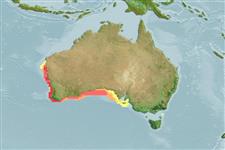
Eastern Indian Ocean: Western Australia. Sympatric with O. maculatus and O. ornatus.
الحجم / وزن / العمر
النضج: Lm ? range ? - ? cm
Max length : 149 cm TL ذكر/ مختلط الجنس; (Ref. 58024)
وصف مختصر
مفاتيح التعريف | الوصف الخارجي | قياسات المظهر الخارجي
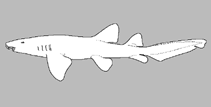
Diagnosis: A moderate-sized species with the following characters: yellowish-brown when fresh with well-defined, darker brown saddles; absence fo white spots, blotches or reticulations on the fins and body; nasal barbel bilobed; postspiracular lobes are simple, reduced or rudimentary; distance across preorbital lobe group 1.2-1.3 times interspace between preorbital group and postspiracular lobe, 13-15 times base length of anterior postspiracular lobe; base of anterior postspiracular lobe 11-12 in its distance from postorbital group, 4.9-7 in its distance from posterior postspiracular lobe; mouth width 4.7-10.2 times preoral distance; warty tubercles absent on back of adult; juveniles with rows of elevated denticles or poorly defined warty tubercles on back; dorsal fins raked posteriorly; first dorsal fin over rear half of pelvic -fin bases; interdorsal space 0.38-0.56 times anal-fin base length; anal-fin inner margin 0.8-1.1 times anal-fin posterior margin; teeth in upper jaw 25-27, those in the medial row at symphysis rudimentary; spiral valve turns 26-28; monospondylous centra 48-50 (Ref. 58024).
Body shape (shape guide): elongated.
Males mature at about 111 cm TL. Young born at 22-26 cm TL (mean 24.1 cm TL based on 40 specimens). Caught as by-catch of local gillnet, longline, rock lobster and recreational fisheries (Ref. 58024).
دورة الحياة وسلوك التزاوج
النضج | التكاثر | وضع البيض | بيض | الخصوبة | اليرقات
Last, P.R., J.A. Chidlow and L.J.V. Compagno, 2006. A new wobbegong shark, Orectolobus hutchinsi n. sp. (Orectolobiformes: Orectolobidae) from southwestern Australia. Zootaxa 1239:35-48. (Ref. 58024)
حالة القائمة الحمراء للاتحاد الدولي لحفظ الطبيعة والموارد الطبيعية (Ref. 130435: Version 2025-2 (Global))
استخدامات بشرية
أدوات
تقارير خاصة
تنزيل XML
مصادر علي الأنترنت
تقديرات تستند إلى النماذج
درجة الحرارة المفضلة (مرجع
123201): 17.4 - 22.3, mean 18.3 °C (based on 126 cells).
مؤشر التنوع الشُعبي الوراثي (مرجع
82804): PD
50 = 0.5012 [Uniqueness, from 0.5 = low to 2.0 = high].
Bayesian length-weight: a=0.00389 (0.00180 - 0.00842), b=3.12 (2.94 - 3.30), in cm total length, based on all LWR estimates for this body shape (Ref.
93245).
مستوى غذائي (مرجع
69278): 4.0 ±0.6 se; based on size and trophs of closest relatives
Generation time: 9.4 ( na - na) years. Estimated as median ln(3)/K based on 1
growth studies.
ضعف الصيد (Ref.
59153): Very high vulnerability (89 of 100).
🛈