Klassifizierung / Names
Namen | Synonyme | Catalog of Fishes(Gattung, Arten) | ITIS | CoL | WoRMS | Cloffa
Elasmobranchii (Haie und Rochen) (sharks and rays) >
Rajiformes (Skates and rays) >
Arhynchobatidae (Softnose skates)
Etymology: leviveneta: Name from latin 'laevis' meaning smooth, bald and 'venetus' for sea-colored or blue, referring to the appearance of the dorsal disc.
More on authors: Last & McEachran.
Umwelt: Milieu / Klimazone / Tiefenbereich / Verbreitungsgebiet
Ökologie
seewasser bathydemersal; tiefenbereich 300 - 1200 m (Ref. 58023). Deep-water
Southwest Pacific: Lord Howe Rise, Challenger Plateau and northern continental slope of New Zealand south to the Clatham Rise, onto the Campbell Plateau, Pukaki Rise and Bounty Platform.
Größe / Gewicht / Alter
Geschlechtsreife: Lm ? range ? - ? cm
Max length : 50.9 cm Männchen/unbestimmt; (Ref. 58023)
Kurzbeschreibung
Bestimmungsschlüssel | Morphologie | Morphometrie
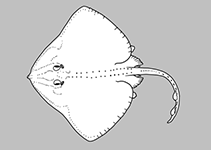
A small species having the following diagnostic characters: long tail, 1.2-1.3 times disc length, 2.1-2.6 times ventral head length, 4-5 times snout length; large orbit, 2.6-3.4 in preorbital snout length; tail base moderately broad, width at pelvic-fin insertions 1.9-2.7 times width at midlength; denticles confined to central disc behind eye; tail thorns in single, median row; single, well-developed preorbital and postorbital thorns; ventral disc and tail naked; rostral thorn bifurcated, pronounced, close to snout tip, distance from snout tip 3-4.3 in preorbital length; calcified rostral shaft long; alar thorns in small patch of long-based, posteromedially directed thorns flanked laterally by patch of much smaller, more posteriorly directed malar thorns; additional malar thorn patch lateral to eye, usually separate from posterior patch; upper surface bluish, ventral surface much darker bluish brown; rows of strongly contrasted, pale-edged pores on ventral surface; nuchal pore band is distinct; total pectoral radials 64-69; predorsal vertebrae 95-100; tooth rows in the upper jaw 32-43 (Ref. 58023).
Body shape (shape guide): other.
Male paratype mature at 43.2 cm TL (Ref. 58023).
Lebenszyklus und Paarungsverhalten
Geschlechtsreife | Fortpflanzung | Ablaichen | Eier | Fruchtbarkeit | Larven
Last, P.R. and J.D. McEachran, 2006. New softnose skate genus Brochiraja from New Zealand (Rajidae: Arhynchobatinae) with description of four new species. N. Z. J. Mar. Freshwater Res. 40(1):65-90. (Ref. 58023)
IUCN Rote Liste Status (Ref. 130435: Version 2025-2 (Global))
Bedrohung für Menschen
Harmless
Nutzung durch Menschen
Tools
Zusatzinformationen
Download XML
Internet Quellen
Schätzungen auf der Grundlage von Modellen
Phylogenetischer Diversitätsindex (Ref.
82804): PD
50 = 0.5039 [Uniqueness, from 0.5 = low to 2.0 = high].
Bayesian length-weight: a=0.00550 (0.00279 - 0.01081), b=3.11 (2.94 - 3.28), in cm total length, based on LWR estimates for this (Sub)family-body shape (Ref.
93245).
Trophische Ebene (Ref.
69278): 3.8 ±0.7 se; based on size and trophs of closest relatives
Widerstandsfähigkeit (Ref.
120179): mittel, Verdopplung der Population dauert 1,4 - 4,4 Jahre. (Preliminary K or Fecundity.).
Anfälligkeit der Fischerei (Ref.
59153): Moderate vulnerability (42 of 100).
🛈