Elasmobranchi (squali e razze) (sharks and rays) >
Carcharhiniformes (Ground sharks) >
Proscylliidae (Finback catsharks)
Etymology: Proscyllium: pro (L.), in front of, probably referring to far forward placement of dorsal fin compared with Scyllium (=Scyliorhinus, Scyliorhinidae) (See ETYFish); magnificum: Latin for noble or splendid, referring to its “strikingly beautiful” color pattern (See ETYFish).
More on authors: Last & Vongpanich.
Ambiente: milieu / zona climatica / distribuzione batimetrica / gamma di distribuzione
Ecologia
marino pelagic-oceanic; distribuzione batimetrica ? - 144 m (Ref. 58071). Tropical
Eastern Indian Ocean.
Dimensione / Peso / Età
Maturità: Lm ? range ? - ? cm
Max length : 49.0 cm TL maschio/sesso non determinato; (Ref. 58071)
Breve descrizione
Chiavi di identificazione | Morfologia | Morfometria
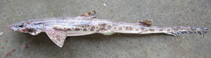
A slender finback catshark that is characterized by the following: second dorsal-fin apex over anal fin with its origin slightly forward of the anal-fin origin; interdorsal distance subequal to head length; snout to cloaca length more than twice (2.1-2.3 times) interdorsal distance; lower labial furrow more than twice (2.7-3.7 times) length of upper furrow; anterior nasal flaps with a greatly enlarged posterior lobe; internarial space only slightly shorter than nostril width; dorsal margin of caudal fin about twice (1.9-2 times) length of second dorsal fin; height of second dorsal fin about twice (1.9-2.1 times) height of anal fin; dorsal surface and sides with a striking color pattern consisting of numerous dark spots and blotches, some equal or large than eye diameter; white spots on body absent; monospondylous centra 38-39; total centra 140-143 (Ref. 58071).
Body shape (shape guide): elongated.
Ciclo vitale e comportamento di accoppiamento
Maturità | Riproduzione | Deposizione | Uova | Fecondità | Larve
Last, P.R. and V. Vongpanich, 2004. A new finback catshark Proscyllium magnificum (Elasmobranchii: Proscylliidae) from the northeastern Indian Ocean. Phuket Mar. Biol. Center Res. Bull. (65):23-29. (Ref. 58071)
Stato della Lista Rossa IUCN (Ref. 130435: Version 2025-2 (Global))
Minaccia per l'uomo
Harmless
Usi umani
Strumenti
Rapporti speciali
Scarica XML
Fonti Internet
Stime basate su modelli
Indice di diversità filogenetica (Fonte Biblio.
82804): PD
50 = 0.6328 [Uniqueness, from 0.5 = low to 2.0 = high].
Bayesian length-weight: a=0.00288 (0.00112 - 0.00741), b=3.14 (2.91 - 3.37), in cm total length, based on LWR estimates for this (Sub)family-body shape (Ref.
93245).
Livello trofico (Fonte Biblio.
69278): 4.0 ±0.6 se; based on size and trophs of closest relatives
Vulnerabilità della pesca (Ref.
59153): Moderate vulnerability (39 of 100).
🛈