Ταξινόμηση / Ονόματα
Κοινά ονόματα | Συνώνυμα | Catalog of Fishes(Γένος, Είδη) | ITIS | CoL | WoRMS | Cloffa
>
Blenniiformes (Blennies) >
Tripterygiidae (Triplefin blennies) > Tripterygiinae
Etymology: Tripterygion: Greek, tres tria = three + Greek, pteron = wing, fin; diminutive (Ref. 45335); tartessicum: Named for the old Spanish culture (Tartessos, at least dating from 1000 BC), located on the south coast of the Iberian peninsula (in modern Andalusia, Spain), where the new species is partially distributed.
Περιβάλλον: περιβάλλον / κλιματική ζώνη / εύρος βάθους / εύρος διανομής
Οικολογία
Θαλασσινό(ά) βενθικό(ς); εύρος βάθους 0 - 6 m (Ref. 58124), usually 0 - 3 m (Ref. 58124). Tropical
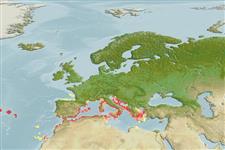
Mediterranean and Eastern Central Atlantic: along the southern coast of Spain, from Plage David (Morocco) to Tunisia.
Μέγεθος / Βάρος / Ηλικία
Γεννητική Ωρίμανση: Lm ? range ? - ? cm
Max length : 7.7 cm TL αρσενικό/απροσδιόριστο; (Ref. 58124)
Σύντομη περιγραφή
Κλείδες προσδιορισμού | Μορφολογία | Μορφομετρία
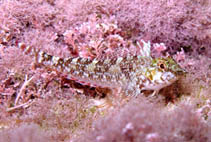
Ραχιαίες άκανθες (συνολικά) : 19 - 21; Μαλακές ραχιαίες ακτίνες (συνολικά) : 12 - 13; Εδρικές άκανθες: 2; Μαλακές εδρικές ακτίνες: 22 - 24. This species has an elongated and compressed body, greatest height at base of anal fin, being about one-sixth total length. Entire body with ctenoid scales except base of pectoral fin and ventral abdominal region back to vent. Lateral line with an anterior section with 20 (19-22) pored scales, and a posterior section with 22 (21-24) notched scales, total of 42 (40-46). Upper, anterior, section commencing at upper angle of opercular opening, slightly curving up over the pectoral fin base and running parallel to the dorsal profile to a point below last 1-3 rays of second dorsal fin; canal running across exposed width of each scale. Lower,
posterior, section commencing below, and in front of last scale or two of upper section, running along the mid-line of tail to caudal fin base; each scale with shallow notch in free-edge tip (Ref. 58124).
Adults inhabit similar habitats to Tripterygion tripteronotus, shallow rocky shores to 6 m,
preferably between 0 and 3 m; in light-exposed and shady biotopes dominated by algal communities (e.g. Corallina elongata, Cladophora spp., Litophyllum spp., Enteromorpha spp.). Nests are usually situated in sciaphyl habitats dominated by
steep rocky zones, without arborescent algae (Ref. 58124). Eggs are hemispherical and covered with numerous sticky threads that anchor them in the algae on the nesting sites (Ref. 240). Larvae are planktonic which occur primarily in shallow, nearshore waters (Ref. 94114).
Κύκλος ζωής και συμπεριφορά ζευγαρώματος
Γεννητική Ωρίμανση | Αναπαραγωγή | Γεννοβολία | Αβγά | Γονιμότητα | Προνύμφες
Carreras-Carbonell, J., M. Pascual and E. Macpherson, 2007. A review of the Tripterygion tripteronotus (Risso, 1810) complex, with a description of a new species from the Mediterranean Sea (Teleostei: Tripterygiidae). Scientia Marina 71(1):75-86. (Ref. 58124)
Κατάσταση Κόκκινου Καταλόγου IUCN (Ref. 130435: Version 2025-2 (Global))
Απειλή για τον άνθρωπο
Harmless
Ανθρώπινες χρήσεις
Εργαλεία
Ειδικές εκθέσεις
Λήψη XML
Διαδικτυακές πηγές
Εκτιμήσεις βάσει μοντέλων
Προτιμώμενη θερμοκρασία (Αναφ.
123201): 17.6 - 20.1, mean 18.9 °C (based on 213 cells).
Δείκτης φυλογενετικής ποικιλότητας (Αναφ.
82804): PD
50 = 0.5625 [Uniqueness, from 0.5 = low to 2.0 = high].
Bayesian length-weight: a=0.00794 (0.00442 - 0.01428), b=3.07 (2.91 - 3.23), in cm total length, based on LWR estimates for this species & (Sub)family-body (Ref.
93245).
Τροφικό Επίπεδο (Αναφ.
69278): 3.4 ±0.4 se; based on size and trophs of closest relatives
Ελαστικότητα (Αναφ.
120179): Υψηλό, ελάχιστος χρόνος για διπλασιασμό πληθυσμού < 15 μήνες (Preliminary K or Fecundity.).
Ευπάθεια στην αλιεία (Ref.
59153): Low vulnerability (10 of 100).
🛈