Elasmobranchi (squali e razze) (sharks and rays) >
Myliobatiformes (Stingrays) >
Dasyatidae (Stingrays) > Urogymninae
Etymology: Urogymnus: Greek, oura = tail + Greek, gymnos = naked (Ref. 45335); lobistoma: Name from Latin 'lobus' for elongated projection or protuberance and 'stoma' for mouth, refers to its protrusible, tubelike mouth.
More on authors: Manjaji-Matsumoto & Last.
Ambiente: milieu / zona climatica / distribuzione batimetrica / gamma di distribuzione
Ecologia
marino benthopelagico. Tropical
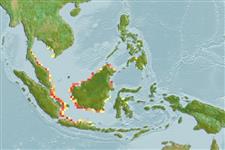
Indo-Malay Archipelago: from Sumatra to Borneo.
Dimensione / Peso / Età
Maturità: Lm ? range ? - ? cm
Max length : 49.2 cm WD maschio/sesso non determinato; (Ref. 58327); 100.0 cm WD (female)
Breve descrizione
Chiavi di identificazione | Morfologia | Morfometria
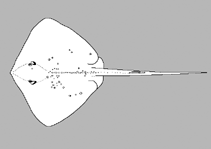
This species belong to the 'uarnacoides' complex, characterized by the following: lateral disc shape with pectoral fin apices broadly rounded rather than narrowly rounded or angular; color plain (usually uniform light to dark brown dorsally, and pale or whitish ventrally with or without a dark margin; a long and slender whiplike tail and platelike denticles in a broad dorsal band in adults. This species differs from H. hortlei in having a highly protrusible mouth and a pelvic girdle with prominent lateral prepelvic processes (Ref. 58327).
Body shape (shape guide): other.
An inshore species which I s probably with restricted distribution in brackish habitats that are associated with runoff from large rivers. Feeds on small fishes and prawns. Males mature at ca. 49 cm WD, females at ca. 70 cm WD; born at ca. 19 cm WD (Ref. 114953). Female maturity based on a pregnant female; males apparently smaller than females; full term pup 18.4 cm DW (Ref. 58327).
Ciclo vitale e comportamento di accoppiamento
Maturità | Riproduzione | Deposizione | Uova | Fecondità | Larve
Manjaji-Matsumoto, B.M. and P.R. Last, 2006. Himantura lobistoma, a new whipray (Rajiformes: Dasyatidae) from Borneo, with comments on the status of Dasyatis microphthamus. Ichthyol. Res. 53(3):290-297. (Ref. 58327)
Stato della Lista Rossa IUCN (Ref. 130435: Version 2025-2 (Global))
Minaccia per l'uomo
Harmless
Usi umani
Strumenti
Rapporti speciali
Scarica XML
Fonti Internet
Stime basate su modelli
Temperatura preferita (Fonte Biblio.
123201): 28.2 - 29.1, mean 28.8 °C (based on 232 cells).
Indice di diversità filogenetica (Fonte Biblio.
82804): PD
50 = 0.5156 [Uniqueness, from 0.5 = low to 2.0 = high].
Bayesian length-weight: a=0.01023 (0.00482 - 0.02174), b=3.06 (2.86 - 3.26), in cm total length, based on LWR estimates for this (Sub)family-body shape (Ref.
93245).
Livello trofico (Fonte Biblio.
69278): 3.5 ±0.4 se; based on size and trophs of closest relatives
Vulnerabilità della pesca (Ref.
59153): Very high vulnerability (90 of 100).
🛈