Classificazione / Nomi
Nomi Comuni | Sinonimi | Catalog of Fishes(Genere, Specie) | ITIS | CoL | WoRMS | Cloffa
>
Gobiiformes (Gobies) >
Gobiidae (Gobies) > Gobiinae
Etymology: Benthophilus: Greek, benthos = depth of the sea + Greek, phyle, that loves (Ref. 45335).
Eponymy: Lev (Leo) Semionovitch (Semenovich) Berg (1876–1950). (See Berg) (Ref. 128868), visit book page.
More on author: Berg.
Ambiente: milieu / zona climatica / distribuzione batimetrica / gamma di distribuzione
Ecologia
; acqua dolce; salmastro demersale. Boreal
Europe and Asia: Northern, western and southern parts of Caspian Sea; lower reaches of Volga up to Astrakhan.
Dimensione / Peso / Età
Maturità: Lm ? range ? - ? cm
Max length : 14.3 cm TL maschio/sesso non determinato; (Ref. 85452)
Breve descrizione
Chiavi di identificazione | Morfologia | Morfometria
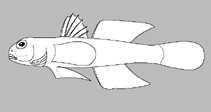
This species is distinguished from its congeners by the following characters: 2 tubercles between the eyes; projecting upper jaw distinct; tubercles in dorsal row 27-30, ventral row 27-30, upper lateral row 15-24 but the lower one usually absent; granules few or sparse on head and back in front of first dorsal; a few larger ones between upper lateral and dorsal rows of tubercles; chin barbel slightly compressed, half of eye diameter in length; D1 III-IV; sides with dark blotches and irregular dots (Ref. 59043).
Body shape (shape guide): elongated.
This species is rarely found in marine waters for it prefers salinity below 9 ppt. Occurs in still or slowly flowing water over muddy bottom at depths of around 0.5-10 m in summer and moves to deeper waters in winter. It lives for a about a year; spawns in April-October. Females lay eggs in two portions, sometimes more and die shortly after last release of eggs while the males die 3-4 weeks later. The males probably guard a clutch of eggs until hatching. Feeds on benthic invertebrates, mainly molluscs (Ref.59043).
Ciclo vitale e comportamento di accoppiamento
Maturità | Riproduzione | Deposizione | Uova | Fecondità | Larve
Females lay eggs in two, sometimes more, portions. Females die shortly after last release of eggs, males 3-4 weeks later. (Ref.59043).
Bogutskaya, N.G. and A.M. Naseka, 2002. REGIONAL CHECK-LISTS: Volga River Drainage Area. In Website and Database: "Freshwater Fishes of Russia": A Source of Information on the Current State of the Fauna. Zoological Institute RAS. (Ref. 58297)
Stato della Lista Rossa IUCN (Ref. 130435: Version 2025-2 (Global))
Minaccia per l'uomo
Harmless
Usi umani
Strumenti
Rapporti speciali
Scarica XML
Fonti Internet
Stime basate su modelli
Indice di diversità filogenetica (Fonte Biblio.
82804): PD
50 = 0.5000 [Uniqueness, from 0.5 = low to 2.0 = high].
Bayesian length-weight: a=0.00977 (0.00541 - 0.01765), b=3.01 (2.86 - 3.16), in cm total length, based on LWR estimates for this species & (Sub)family-body (Ref.
93245).
Livello trofico (Fonte Biblio.
69278): 3.4 ±0.4 se; based on size and trophs of closest relatives
Resilienza (Fonte Biblio.
120179): Alto, tempo minimo di raddoppiamento della popolazione meno di 15 mesi (Preliminary K or Fecundity.).
Vulnerabilità della pesca (Ref.
59153): Low vulnerability (10 of 100).
🛈