>
Gobiiformes (Gobies) >
Gobiidae (Gobies) > Gobionellinae
Etymology: Gymnogobius: Greek, gymnos = naked + Latin, gobius = gudgeon (Ref. 45335); opperiens: Name from Latin 'opperior' meaning to wait or expect, its present participle meaning 'waiting', alluding to it being recognized as new for more than 20 years and has long awaited formal description.
Ambiente: milieu / zona climatica / distribuzione batimetrica / gamma di distribuzione
Ecologia
marino; acqua dolce; salmastro demersale; amfidromo (Ref. 58909). Temperate
Northwest Japan (NE and central Honshu and southern Hokkaido), Kuril Is. (Kunashir), southern Sakhalin, and southern Primorski Krai in Russian Far East.
Dimensione / Peso / Età
Maturità: Lm ? range ? - ? cm
Max length : 8.1 cm SL maschio/sesso non determinato; (Ref. 81467)
Breve descrizione
Chiavi di identificazione | Morfologia | Morfometria
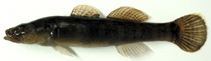
Spine dorsali (totale) : 6 - 7; Spine anali: 1; Raggi anali molli: 9 - 12. This species is distinguished by the following characters: base of caudal fine with a dark, y-shaped blotch and when fresh white spots on the pectoral fin near its insertion; head broad and depressed, the width greater than its depth; anterior oculoscapular canals reaching beyond postorbital region, opening through paired C, D, F, and G pores; right and left D pores distinct, separated by less than 1/3 orbital diameter; several sensory papillae in row 'n'; anteriorly protruding lower jaw beyond the upper one; maxilla extending posteriorly to or beyond posterior margin of eye; posterolateral end of mental flap indistinct; no fleshy, barbel-like processes behind chin; body with a series of broad bands formed by dark pigment patches; dusky caudal fin with dark blotches forming distich bands; predorsal scales 19-26; longitudinal scale series 71-78; modal vertebral count 15 + 18; first dorsal fin often with 6 spines, anteriormost pterygiophore usually inserted in 4th interneural space; modal second dorsal fin ray I,11, anteriormost pterygiophore usually inserted in 11th interneural space; modal anal fin ray count I,11, origin anterior to 3rd soft ray or second dorsal; first dorsal fin with distinct oblique bands, a dark blotch on posterior margin (Ref. 81467).
Body shape (shape guide): fusiform / normal.
Often hidden among rocks in shallow, fast-moving, rock bottom streams and rivers. Collected in water temperatures exceeding 30°C (Ref. 81467).
Ciclo vitale e comportamento di accoppiamento
Maturità | Riproduzione | Deposizione | Uova | Fecondità | Larve
Stevenson, D.E., 2002. Systematics and distribution of fishes of the Asian goby genera Chaenogobius and Gymnogobius (Osteichthyes: Perciformes: Gobiidae), with the description of a new species. Spec. Divers. 7(3):251-312. (Ref. 81467)
Stato della Lista Rossa IUCN (Ref. 130435: Version 2025-2 (Global))
Minaccia per l'uomo
Harmless
Usi umani
Strumenti
Rapporti speciali
Scarica XML
Fonti Internet
Stime basate su modelli
Indice di diversità filogenetica (Fonte Biblio.
82804): PD
50 = 0.5000 [Uniqueness, from 0.5 = low to 2.0 = high].
Bayesian length-weight: a=0.01023 (0.00452 - 0.02316), b=3.00 (2.81 - 3.19), in cm total length, based on LWR estimates for this (Sub)family-body shape (Ref.
93245).
Livello trofico (Fonte Biblio.
69278): 3.2 ±0.3 se; based on size and trophs of closest relatives
Resilienza (Fonte Biblio.
120179): Alto, tempo minimo di raddoppiamento della popolazione meno di 15 mesi (Preliminary K or Fecundity.).
Vulnerabilità della pesca (Ref.
59153): Low vulnerability (10 of 100).
🛈