Classificatie / Namen
Lokale namen | Synoniemen | Catalog of Fishes(Genus, Soort(en)) | ITIS | CoL | WoRMS | Cloffa
>
Siluriformes (Catfishes) >
Trichomycteridae (Pencil or parasitic catfishes) > Trichomycterinae
Etymology: Ituglanis: Greek, itys, ityos = circle + Greek, glanis = a fish that can eat the bait without touching the hook; a cat fish (Ref. 45335); paraguassuensis: The name paraguassuensis refers to the type locality, rio Paraguaçu.
More on authors: Campos-Paiva & Costa.
Milieu: milieu / Klimaatzone / Diepte / verspreidingsgebied
Ecologie
; zoet water benthopelagisch. Tropical
South America: Brazil. Known only from the type locality, rio Paraguaçu near Iassu, Estado da Bahia, northeastern
Brazil (Ref. 58334)
Grootte / Gewicht / Leeftijd
Maturiteit: Lm ? range ? - ? cm
Max length : 4.3 cm SL mannelijk / geslacht onbekend; (Ref. 116503)
Korte beschrijving
Determinatiesleutels | Morfologie | Morfometrie
Distinguished from all other species of the genus by the following combination of characteristics:
color pale yellow on lateral and dorsal regions of head and body, whiter on ventral. Skin covered by
several irregular pale brown blotches aligned along the body (vs. distinct color patterns in all other Ituglanis); pectoral fin-rays i,6 (vs. i,4 in I. macuniama, I. cahyensis and I. parahybae; i,5 in I. amazonicus, I. eichorniarium,
I. metae and I. nebulosus; i,7 in I. bambui, I. passensis, I. epikarsticus; i,8 in I. ramiroi except in I. parkoi, I. proops and I. laticeps); pelvic-fin-rays i,4 (vs. i,3 in I. eichorniarium and I. cahyensis or pelvic-fin absent in I. parahybae; i,5 in I. amazonicus, I. passensis except in I. gracilior, I. nebulosus, I. macunaima, I. bambui, I. ramiroi, I. epikasticus, I. parkoi, and I. guayaberensis); parietal fontanel extending to posterior edge of medial parietal border (vs. parietal fontanel reduced or vestigial, restricted to middle of medial parietal border in all other Ituglanis except in some I. amazonicus and I. proops); the unusual reduced number of vertebrae 34–36, where vertebral counts normally range 39 or more (in I. amazonicus, I. cahyensis, I. eichorniarium, I. parahybae, I. proops, I. gracilior, I. herberti, I. metae, Ituglanis sp. A).
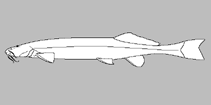
Body shape (shape guide): elongated.
Levenscyclus en paargedrag
Maturiteit | Voortplanting | Paaien | Eieren | Fecunditeit | Larven
Campos-Paiva, R.M. and W.J.E.M. Costa, 2007. Ituglanis paraguassuensis sp. n. (Teleostei: Siluriformes: Trichomycteridae): a new catfish from the rio Paraguaçu, northeastern Brazil. Zootaxa 1471:53-59. (Ref. 58334)
Status op de Rode Lijst van het IUCN (Ref. 130435: Version 2025-2 (Global))
Gevaar voor de mens
Harmless
Gebruik door de mens
Tools
Speciale rapporten
Download XML
Internetbronnen
Schattingen op basis van modellen
Fylogenetische diversiteitsindex (Ref.
82804): PD
50 = 0.5000 [Uniqueness, from 0.5 = low to 2.0 = high].
Bayesian length-weight: a=0.00759 (0.00337 - 0.01709), b=3.00 (2.81 - 3.19), in cm total length, based on LWR estimates for this (Sub)family-body shape (Ref.
93245).
Trofisch niveau (Ref.
69278): 3.1 ±0.4 se; based on size and trophs of closest relatives
Kwetsbaarheid van de visserij (Ref.
59153): Low vulnerability (10 of 100).
🛈