>
Perciformes/Scorpaenoidei (Scorpionfishes) >
Sebastidae (Rockfishes, rockcods and thornyheads) > Sebastolobinae
Etymology: Trachyscorpia: Greek, trachys, -eia, y = rough + Greek, skorpis, idos = a kind of fish without identification (Ref. 45335); carnomagula: The specific name carnomagula is derived from the Latin carnosus meaning fleshy, and
magulum meaning jaw or mouth, in reference to the fleshy lip on the upper jaw, compared with the poorly developed lip of T. eschmeyeri. The E.
More on authors: Motomura, Last & Yearsley.
Milieu: milieu / Klimaatzone / Diepte / verspreidingsgebied
Ecologie
marien benthopelagisch; diepte 731 - 1020 m (Ref. 58335). Temperate
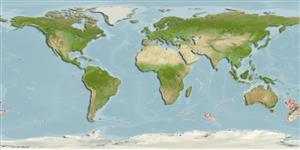
Pacific Ocean: currently known only from the southwestern Pacific Ocean (Tasman Sea and northern New Zealand) at depths of 731-1020 m. One specimen (CSIRO H 2625-02, 263.3 mm SL, non-type), tentatively identified as T. carnomagula in ref. 58335 , was collected from southwest of Western Australia, Indian Ocean, at a depth of 738–750 m. Trachyscorpia carnomagula co-occurs with T. eschmeyeri.
Grootte / Gewicht / Leeftijd
Maturiteit: Lm ? range ? - ? cm
Max length : 36.9 cm SL mannelijk / geslacht onbekend; (Ref. 58335)
Korte beschrijving
Determinatiesleutels | Morfologie | Morfometrie
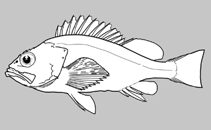
Dorsale stekels (totaal) : 13; Wervels: 26. Tympanic spines present; upper-jaw lip well developed, covering most of premaxillary tooth band laterally; no scales on lateral surface of maxilla; 57–63 scale rows in longitudinal series; second pelvicfin soft ray short (17.9-24.9% SL, mean 20.3%), shorter than upper-jaw length; body deep (depth 34.3-42.5% of SL, mean 38.0%); orbit diameter large (14.1–18.0% of SL, mean 16.1%); pelvic-fin spine short (9.4–15.9% of SL, mean 12.4%); first anal-fin spine short (5.1–7.7% of SL, mean 6.4%); head profile convex; swimbladder
present; head and trunk whitish with two blackish bands from eye on head and 4 blackish saddles on body in preserved specimens (Ref. 58335).
Levenscyclus en paargedrag
Maturiteit | Voortplanting | Paaien | Eieren | Fecunditeit | Larven
Motomura, H., P.R. Last and G.K. Yearsley, 2007. Two new species of the scorpionfish genus Trachyscorpia (Sebastidae: Sebastolobinae) from the southern Indo-West Pacific, with comments on the distribution of T. eschmeyeri. Zootaxa 1466:19-34. (Ref. 58335)
Status op de Rode Lijst van het IUCN (Ref. 130435: Version 2025-2 (Global))
Gevaar voor de mens
Harmless
Gebruik door de mens
Tools
Speciale rapporten
Download XML
Internetbronnen
Schattingen op basis van modellen
Gewenste temperatuur (Ref.
123201): 2.1 - 7.5, mean 6.1 °C (based on 72 cells).
Fylogenetische diversiteitsindex (Ref.
82804): PD
50 = 0.5078 [Uniqueness, from 0.5 = low to 2.0 = high].
Bayesian length-weight: a=0.00912 (0.00405 - 0.02055), b=3.09 (2.89 - 3.29), in cm total length, based on LWR estimates for this (Sub)family-body shape (Ref.
93245).
Trofisch niveau (Ref.
69278): 3.8 ±0.5 se; based on size and trophs of closest relatives
Weerstandsvermogen (Ref.
120179): laag, minimale populatieverdubbelingstijd 4,5-14 jaar (Preliminary K or Fecundity.).
Kwetsbaarheid van de visserij (Ref.
59153): Low to moderate vulnerability (35 of 100).
🛈