>
Gobiiformes (Gobies) >
Gobiidae (Gobies) > Gobiinae
Etymology: Elacatinus: Greek, elakatines = fusiform fishes preserved in salt (Ref. 45335); jarocho: Named for Jarocho, the common local name for Veracruzanos, the native people of Veracruz, Mexico; noun in apposition. Authors are pleased to honor the Jarocho, who have embraced the protection and conservation of the Veracruz.
Ambiente: milieu / zona climática / intervalo de profundidade / gama de distribuição
Ecologia
marinhas associadas(os) a recifes; intervalo de profundidade 3 - 25 m (Ref. 58341). Subtropical; 21°N - 19°N, 96°W - 97°W
Western Atlantic: Caribbean. Known only from the Veracruz reef system near Veracruz, Mexico (as far north as Isla De Lobos [21°29.36'N, 97°13.53'W] and as far south as Anton Lizardo [ca. 19°04.41'N, 95°50.21'W]).
Tamanho / Peso / Idade
Maturidade: Lm ? range ? - ? cm
Max length : 2.7 cm SL macho/indeterminado; (Ref. 58341)
Descrição breve
Chaves de identificação | Morfologia | Morfometria
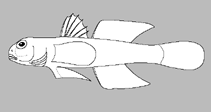
Espinhos dorsais (total) : 7; Raios dorsais moles (total) : 11 - 12; Espinhos anais: 1; Raios anais moles: 9 - 11. Elacatinus jarocho is readily distinguished from other species of Elacatinus (s.s.) by the disjunct yellow lateral stripe that appears as a dash over the eye and on the caudal fin, a yellow medial stripe on the snout, and a black ovoid to rectangular spot at the base of the caudal fin, immediately ventral to the yellow dash (Ref. 58341).
Body shape (shape guide): fusiform / normal.
This species was found between 3-25 m depth on high profile coral reefs typically dominated by Montastrea cavernosa (Linneaus), M. annularis (Ellis and Solander), Colpophyllia natans (Houttuyn) and skeletal reef framework. Elacatinus jarocho joins E. atronasus (Böhlke & Robins) as the only two species in the genus to school in the water column. Small to large aggregations (12-60 individuals) of E. jarocho were normally found close to the reef near high profile corals or overhangs. Such reef structure presumably provides shelter from direct sunlight because aggregations were usually observed in darker, shaded areas rather than in direct sunlight. Individuals of E. jarocho, unlike E. atronasus, were never observed stationary on any substrate, but rather hovered continuously about 5–25 cm above the reef, frequently in association
with Coryphopterus hyalinus Böhlke & Robins or C. personatus (Jordan & Thompson). This species was not observed to clean other species or interact in other symbiotic relationships. Small and large individuals coexisted in the same aggregations and did not display territorial or hierarchical behaviors. Individual fish would often, though not always, move slowly toward cover when approached to less than 1 m by scuba divers (Ref. 58341).
Ciclo de vida e comportamento de acasalamento
Maturidade | Reprodução | Desova | Ovos | Fecundidade | Larvas
Taylor, M.S. and L. Akins, 2007. Two new species of Elacatinus (Teleostei: Gobiidae) from the Mexican coast of the Gulf of Mexico. Zootaxa 1425(1):45-51. (Ref. 58341)
Categoria na Lista Vermelha da IUCN (Ref. 130435: Version 2025-2 (Global))
Ameaça para o homem
Harmless
Utilização humana
Ferramentas
Relatórios especiais
Descarregue XML
Fontes da internet
Estimativas baseadas em modelos
Índice de diversidade filogenética (Ref.
82804): PD
50 = 0.5000 [Uniqueness, from 0.5 = low to 2.0 = high].
Bayesian length-weight: a=0.01023 (0.00477 - 0.02194), b=3.01 (2.83 - 3.19), in cm total length, based on LWR estimates for this (Sub)family-body shape (Ref.
93245).
Nível Trófico (Ref.
69278): 3.3 ±0.3 se; based on size and trophs of closest relatives
Resiliência (Ref.
120179): Elevada, tempo mínimo de duplicação da população menor que 15 meses (Preliminary K or Fecundity.).
Vulnerabilidade da pesca (Ref.
59153): Low vulnerability (10 of 100).
🛈