Classification / Noms
Noms communs | Synonymes | Catalog of Fishes(Genre, Espèce) | ITIS | CoL | WoRMS | Cloffa
>
Cyprinodontiformes (Rivulines, killifishes and live bearers) >
Aphaniidae (Oriental killifishes)
Etymology: almiriensis: Named for its type locality, Kato Almiri, Peloponnese, Greece.
More on authors: Kottelat, Barbieri & Stoumboudi.
Environnement : milieu / zone climatique / profondeur / gamme de distribution
Écologie
; eau douce; saumâtre benthopélagique. Temperate
Europe: Greece and Turkey.
Taille / Poids / Âge
Maturité: Lm ? range ? - ? cm
Max length : 2.9 cm SL mâle / non sexé; (Ref. 58344); 3.9 cm SL (female)
Description synthétique
Clés d'identification | Morphologie | Morphométrie
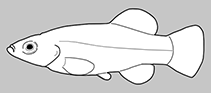
Rayons mous dorsaux (Total) : 9 - 11; Rayons mous anaux: 10 - 11. The species is distinguished from its congeners by the following: yellow caudal of the male, with a wide faint grey margin (vs. hyaline, greyish, greyish blue, or bright yellow with or without a black subdistal bar); color pattern of the female with 7-11 dark, roundish blotches on the side, more or less connected by an irregular dark midlateral stripe; additionally, (not unique to it), male with 6-10 dark, broad, regularly set bars on the body; neuromasts in interorbital area in deep open grooves; 25-28+2 scales in lateral series on body; and 15-16 pectoral rays (Ref. 58344).
Body shape (shape guide): fusiform / normal; Cross section: compressed.
Benthopelagic adults inhabit fresh and brackish water springs with salinity of up to 23 ppt. They are observed in shallow areas with slow current, among vegetation, as well as in the water column. They are short-lived, form schools and fast swimmers. Mature females are fractional spawners that breed in late spring - early summer, spawning 1-3 eggs a time (apparently the reproductive period may be prolonged until late summer) (Ref. 58344).
Cycle de vie et comportement reproducteur
Maturité | Reproduction | Frai | Œufs | Fécondité | Larves
Freyhof, J. and B. Yoğurtçuoğlu, 2020. A proposal for a new generic structure of the killifish family Aphaniidae, with the description of Aphaniops teimorii (Teleostei: Cyprinodontiformes). Zootaxa 4810(3):421-451. (Ref. 126233)
Statut dans la liste rouge de l'IUCN (Ref. 130435: Version 2025-2 (Global))
Menace pour l'homme
Harmless
Utilisations par l'homme
Outils
Articles particuliers
Télécharger en XML
Sources Internet
Estimations basées sur des modèles
Indice de diversité phylogénétique (Réf.
82804): PD
50 = 0.5312 [Uniqueness, from 0.5 = low to 2.0 = high].
Bayesian length-weight: a=0.00933 (0.00418 - 0.02084), b=3.21 (3.03 - 3.39), in cm total length, based on LWR estimates for this (Sub)family-body shape (Ref.
93245).
Niveau trophique (Réf.
69278): 2.9 ±0.4 se; based on size and trophs of closest relatives
Résilience (Réf.
120179): Haut, temps minimum de doublement de population inférieur à 15 mois (Preliminary K or Fecundity.).
Vulnérabilité de la pêche (Ref.
59153): Low vulnerability (10 of 100).
🛈