Classificazione / Nomi
Nomi Comuni | Sinonimi | Catalog of Fishes(Genere, Specie) | ITIS | CoL | WoRMS | Cloffa
>
Perciformes/Percoidei (Perchs) >
Percidae (Perches) > Etheostomatinae
Etymology: Percina: Latin, diminutive of perch = perch (Ref. 45335); sipsi: The specific name, sipsi, is the Chickasaw-Choctaw Indian name for poplar or cottonwood tree, and is the origin of “Sipsey” in the stream name, Sipsey Fork of the Black Warrior River (Foscue 1989), to which this species is endemic. The common name,.
Ambiente: milieu / zona climatica / distribuzione batimetrica / gamma di distribuzione
Ecologia
; acqua dolce benthopelagico; distribuzione batimetrica 0 - 2 m (Ref. 58738). Temperate; 35°N - 33°N, 88°W - 86°W
North America: United States of America. Percina sipsi is known only from the Sipsey Fork of the Black Warrior River in the Bankhead National Forest in northwestern Alabama. It occurs in Borden Creek in Lawrence County, and Brushy Creek, Caney Creek, and Sipsey Fork (recorded as West Fork Sipsey River on some maps) in Winston County. While the current known range of P. sipsi is very limited and confined downstream by Lewis Smith Reservoir, historically it is possible that the species ranged farther downstream in the Sipsey Fork and conceivably in the Locust and Mulberry forks of the Black Warrior River, which are all located in the Cumberland Plateau physiographic province. Riverine habitat in the lower reaches of the Sipsey Fork was destroyed in 1960 by the Alabama Power Company impoundment behind Lewis Smith Dam. The current distribution of P. sipsi represents the most restricted range of any known species of Percina (Ref. 58738).
Dimensione / Peso / Età
Maturità: Lm ? range ? - ? cm
Max length : 5.0 cm SL maschio/sesso non determinato; (Ref. 58738)
Breve descrizione
Chiavi di identificazione | Morfologia | Morfometria
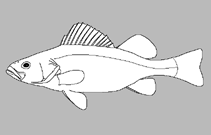
Percina sipsi is one of the two smallest species in the genus Percina, rarely exceeding 50 mm SL (P. brevicauda, maximum SL is 50 mm, see Suttkus et al. 1994). Percina sipsi is distinguished from all other described species of Percina by a combination of the following characteristics: absence of bright colors on body and fins of adults; no orange band in spinous dorsal fin; no broad vertical bands on body extending dorsally across the back joining those of the other side;
7–11 lateral blotches fused into continuous dark brown to black lateral stripe with undulating margins; lateral stripe continuous with large, somewhat quadrate basicaudal blotch that extends onto base of caudal fin rays; small, dark blotch on upper and lower portion of caudal fin base, dorsal blotch typically darker; body below
lateral stripe white to cream colored, without dark blotches, becoming dusky in breeding males; suborbital bar absent or very poorly developed; lateral line complete, typically no pored scales on base of caudal fin; males with row of modified scales on midline of belly and one or two modified scales between base of pelvic fins;modified breast scale absent; nuptial tubercles absent; anal fin of breeding males not excessively elongate; males without caudal keel as a ventral extension of the caudal peduncle; snout does not project beyond anterior margin of upper jaw; broad premaxillary frenum present; serrae on margin of preopercle absent; branchiostegal membranes very narrowly joined to overlapping (Ref. 58738).
Body shape (shape guide): elongated.
Ramsey (1976) published the first conservation status review of Percina sipsi and reported it to be a threatened species. Although the assigned conservation status category has varied in subsequent evaluations (Deacon et al. 1979; Ramsey 1984; Williams et al. 1989; Warren et al. 2000), all authors considered the Bankhead Darter’s continued existence to be in a precarious situation. In the most recent assessment of conservation status of Alabama wildlife, Kuhajda (2004) reported it as a species of highest conservation concern. The entire range of this species is in the Bankhead National Forest, providing some level of protection. the authors consider P. sipsi to be highly endangered based on its restricted distribution, rarity within the occupied range, habitat vulnerability, and absence of downstream habitat for future recovery. Percina sipsi is extremely vulnerable and needs continuous monitoring and proactive management actions to prevent extinction (Ref. 58738). Migratory behaviour is undetermined (Ref. 126106).
Ciclo vitale e comportamento di accoppiamento
Maturità | Riproduzione | Deposizione | Uova | Fecondità | Larve
Williams, J.D., D.A. Neely, S.J. Walsh and N.M. Burkhead, 2007. Three new percid fishes (Percidae: Percina) from the Mobile Basin drainage ofAlabama, Georgia, and Tennessee. Zootaxa 1549:1-28. (Ref. 58738)
Stato della Lista Rossa IUCN (Ref. 130435: Version 2025-2 (Global))
Minaccia per l'uomo
Harmless
Usi umani
Strumenti
Rapporti speciali
Scarica XML
Fonti Internet
Stime basate su modelli
Indice di diversità filogenetica (Fonte Biblio.
82804): PD
50 = 0.5000 [Uniqueness, from 0.5 = low to 2.0 = high].
Bayesian length-weight: a=0.00575 (0.00268 - 0.01234), b=3.13 (2.95 - 3.31), in cm total length, based on LWR estimates for this (Sub)family-body shape (Ref.
93245).
Livello trofico (Fonte Biblio.
69278): 3.2 ±0.4 se; based on size and trophs of closest relatives
Resilienza (Fonte Biblio.
120179): Alto, tempo minimo di raddoppiamento della popolazione meno di 15 mesi (Preliminary K or Fecundity.).
Vulnerabilità della pesca (Ref.
59153): Low vulnerability (10 of 100).
🛈