Classification / Noms
Noms communs | Synonymes | Catalog of Fishes(Genre, Espèce) | ITIS | CoL | WoRMS | Cloffa
>
Cyprinodontiformes (Rivulines, killifishes and live bearers) >
Rivulidae (Rivulines) > Cynolebiinae
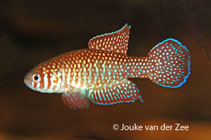
Etymology: punctulatus: From the Latin punctulatus, meaning with dots, in reference to the rows of blue dots on flank in males, a condition distinguishing this species from all other species of the subgenus Simpsonichthys.
Eponymy: Charles J Simpson, California, was a friend of the author. We have been unable to find further details. (Ref. 128868), visit book page.
More on authors: Costa & Brasil.
Environnement : milieu / zone climatique / profondeur / gamme de distribution
Écologie
; eau douce démersal. Tropical
South America: temporary canals of the upper rio Paracatu drainage, rio São Francisco basin in Brazil.
Taille / Poids / Âge
Maturité: Lm ? range ? - ? cm
Max length : 2.9 cm SL mâle / non sexé; (Ref. 58746); 2.4 cm SL (female)
Description synthétique
Clés d'identification | Morphologie | Morphométrie
Rayons mous dorsaux (Total) : 14 - 19; Rayons mous anaux: 17 - 19; Vertèbres: 26 - 27. Differs from all other species of the subgenus Simpsonichthys by having longitudinal rows of light blue dots on flank in males (vs. absence) and a long filamentous ray on tip of dorsal fin in males, reaching the posterior position of caudal fin (vs. reaching basal portion of caudal fin). Can be differentiated from all congeners by the unique combination of the following characters: pelvic fin present (vs. absent), second pharyngobranchial teeth absent (vs. present), ventral process of posttemporal short (vs. long), 18-19 dorsal-fin rays in males and 14-15 in females (vs. 15-17 in males, 12-13 in females), long filamentous ray on tip of dorsal fin males (vs. filamentous rays short or absent), five alternating bright blue and pink to red bars on head side in males (vs. never a similar color pattern), pectoral fin pink with blue spots in males (vs. hyaline), and absence of black spots on dorsal fin in males (vs. presence of black spots on basal portion of dorsal fin). Caudal fin round (Ref. 58746).
Body shape (shape guide): short and / or deep.
Inhabits temporary canals at floodplains (Ref. 58746).
Cycle de vie et comportement reproducteur
Maturité | Reproduction | Frai | Œufs | Fécondité | Larves
Costa, W.J.E.M. and G.C. Brasil, 2007. Simpsonichthys punctulatus n. sp. - a new seasonal killifish (Teleostei: Cyprinodontiformes: Rivulidae) from the upper rio São Francisco basin, central Brazil. Vertebr. Zool. 57(1):57-61. (Ref. 58746)
Statut dans la liste rouge de l'IUCN (Ref. 130435: Version 2025-2 (Global))
Menace pour l'homme
Harmless
Utilisations par l'homme
Outils
Articles particuliers
Télécharger en XML
Sources Internet
Estimations basées sur des modèles
Indice de diversité phylogénétique (Réf.
82804): PD
50 = 0.5000 [Uniqueness, from 0.5 = low to 2.0 = high].
Bayesian length-weight: a=0.01995 (0.00906 - 0.04395), b=3.01 (2.83 - 3.19), in cm total length, based on all LWR estimates for this body shape (Ref.
93245).
Niveau trophique (Réf.
69278): 3.1 ±0.4 se; based on size and trophs of closest relatives
Résilience (Réf.
120179): Haut, temps minimum de doublement de population inférieur à 15 mois (Preliminary K or Fecundity.).
Vulnérabilité de la pêche (Ref.
59153): Low vulnerability (10 of 100).
🛈