التصنيف / الأسماء
الأسماء الشائعة | مرادفات | Catalog of Fishes(جنس, الانواع) | ITIS | CoL | WoRMS | Cloffa
>
Siluriformes (Catfishes) >
Trichomycteridae (Pencil or parasitic catfishes) > Trichomycterinae
Etymology: Trichomycterus: Greek, thrix = hair + Greek, mykter, -eros = nose (Ref. 45335); megantoni: The specific name, megantoni, is in reference to Santuario Nacional Machiguenga Megantoni, where the type locality is situated.
البيئة: الوسط / المنطقة المناخية / نطاق العمق / نطاق التوزيع
البيئة
; المياه العذبة محيطي; نطاق العمق 0 - 2 m (Ref. 58750). Tropical; 12°C - 16°C (Ref. 58750)
Trichomycterus megantoni has been collected at several localities from southeastern Perú at
the Santuario Nacional Machiguenga Megantoni: Quebrada Earoto, elevation 2,100 m, Quebrada Matzonzori, elevation 2,200 m, Quebrada Patiti, elevation 2,200 m, and Quebrada Morro Leguia, km 135, in Paucartambo, Cusco. The region is characterized by torrential hydrological conditions associated with abundant summer rains between January and March and by a dry season between May and November (Ref. 58750).
الحجم / وزن / العمر
النضج: Lm ? range ? - ? cm
Max length : 10.1 cm SL ذكر/ مختلط الجنس; (Ref. 58750)
وصف مختصر
مفاتيح التعريف | الوصف الخارجي | قياسات المظهر الخارجي
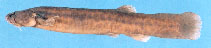
Trichomycterus megantoni is readily distinguished from all other members of the subfamily Trichomycterinae from southern South America by having autapomorphic interopercle thickened integument and the presence of foramen frontal-supraoccipital reduced. It is further distinguished from other congeners, with the exception of T. pseudosilvinichthys (Fernández & Vari) and T. yuska (Fernández & Schaefer), by the unique combination of the following features: tip of the pelvic fin when depressed not reaching the anus, premaxillae rectangle, first dorsal fin pterygiophore insertion at or posterior to vertebra 19 to 21,
17 or 19 pairs of ribs on each side, and 37 to 40 vertebrae. T. megantoni can be distinguished from T. yuska and T. pseudosilvinichthys by the presence of a supraorbital canal with pore 3, and an outer tooth row with conic teeth (versus absence pore 3 and distally narrowing incisiform teeth Fernández & Schaefer, 2003; Fernández & Vari, 2004). In addition, the new species is distinguished from T. yuska by head muscles that are not hypertrophied and 17 pairs of ribs on each side (versus head and cheek musculature hypertrophied and 18 or 19 ribs Fernández & Schaefer, 2003); from T. pseudosilvinichthys by the first pectoral fin ray prolonged as thin short filament (versus first pectoral fin ray terminating at the margin of the fin Fernández & Vari, 2004).
دورة الحياة وسلوك التزاوج
النضج | التكاثر | وضع البيض | بيض | الخصوبة | اليرقات
Fernández, L. and R.Q. Chuquihuamaní, 2007. A new species of Trichomycterus (Siluriformes: Trichomycteridae) from the Andean Cordillera of Perú, with comments on relationships within the genus. Zootaxa 1545:49-57. (Ref. 58750)
حالة القائمة الحمراء للاتحاد الدولي لحفظ الطبيعة والموارد الطبيعية (Ref. 130435: Version 2025-2 (Global))
استخدامات بشرية
أدوات
تقارير خاصة
تنزيل XML
مصادر علي الأنترنت
تقديرات تستند إلى النماذج
مؤشر التنوع الشُعبي الوراثي (مرجع
82804): PD
50 = 0.5000 [Uniqueness, from 0.5 = low to 2.0 = high].
Bayesian length-weight: a=0.00912 (0.00396 - 0.02102), b=2.97 (2.79 - 3.15), in cm total length, based on LWR estimates for this Genus-body shape (Ref.
93245).
مستوى غذائي (مرجع
69278): 3.2 ±0.4 se; based on size and trophs of closest relatives
ضعف الصيد (Ref.
59153): Low vulnerability (10 of 100).
🛈