Классификация / Имена
народные названия | синонимы | Catalog of Fishes(род, виды) | ITIS | CoL | WoRMS | Cloffa
>
Cyprinodontiformes (Rivulines, killifishes and live bearers) >
Nothobranchiidae (African rivulines)
Etymology: Fundulopanchax: Latin, fundus = bottom; a peculiar name for a topminnow, coined for a bottom species of Atlantic coast being "the abode of the fundulus mudfish" + Greek, soma = body; kamdemi: Named for Andre Kamdem Toham of the World Wildlife Fund’s Central African Rainforest Project (CARPE) and a collector of this new species.
Eponymy: Dr André Kamden Toham is a Cameroonese ichthyologist and landscape ecologist who, since 1999, is the Regional Representative, Gabon, for the World Wildlife Fund Central Africa. [...] (Ref. 128868), visit book page.
Окружающая среда: среда / климатическая зона / пределы глубины / диапазон распространения
экология
; пресноводный пелагический; pH range: 5.0 - 7.5; dH range: 0.6 - 1; пределы глубины 0 - 1 m (Ref. 58752). Tropical; 21°C - 24°C (Ref. 58752); 6°N - 4°N, 8°E - 10°E
Africa: Cameroon. Fundulopanchax kamdemi is known from a limited number of localities, all within the Korup National Park. It was mentioned as Aphyosemion sp. 01 (cf. A. cameronense) in McGregor Reid (1989)from the Akpa-Yafe River and the upper Ndian River, in southern Korup only. This was confirmed by comparing the specimens, deposited by Kamdem Toham, as Aphyosemion sp. (KORUP 01) in the collection of the Museum for Central Africa, Tervuren, Belgium. He found them in the swampy parts that edge the small creeks under the cover of the forest in the southern Korup close to the Science camp (Kamdem Toham, 1992). Additionally the three collection localities, studied by the first author, confirmed the presence of the new species in the southern part of the Park only. Presence in the adjacent Oban National Park at the Nigerian side of the border may be possible but could not be confirmed as no collections of cyprinodontiform fishes are known from there. Other cyprinodontiform species found in sympatry with F. kamdemi are F. marmoratus, Epiplatys infrafasciatus (Günther, 1866) (= E. sexfasciatus in McGregor Reid, 1989 and Kamdem Toham, 1992), Aphyosemion (Chromaphyosemion) bivittatum, A. calliurum and Aplocheilichthys spilauchen. All have a larger distribution and are also known from localities outside the park.
Размер / Вес / Возраст
половая зрелость: Lm ? range ? - ? cm
Max length : 7.3 cm SL самец/пол неопределен; (Ref. 58752)
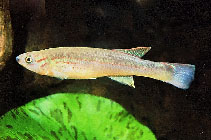
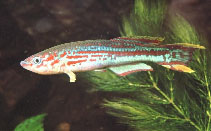
Fundulopanchax kamdemi shares with all other Fundulopanchax species except those of the subgenus Paludopanchax 16 or more scales around the caudal peduncle versus 12 in Aphyosemion s.l. It is distinguished
from all Aphyosemion species and many Fundulopanchax except F. arnoldi, F. deltaensis, F. gularis, F. kribianus, F. ndianus, F. robertsoni, F. rubrolabialis, F. schwoiseri, F. sjoestedti, and F. walkeri by the high number of dorsal (15–18) and anal fin rays (16–19) (according to the descriptions and data in Huber 2000). It is distinguished from all Fundulopanchax species by its unique male coloration of a red longitudinal band on the middle of the sides versus no red band, with the exception of F. amieti, F. avichang, F. deltaensis and some individual specimens of F. ndianus, F. puerzli and F. spoorenbergi. It is distinguished from all Fundulopanchax species, except F. ndianus and some specimens of F. puerzli, by a red ventral band from the pelvic fins to the lower caudal fin base. F. kamdemi is distinguished from the latter species and most other Fundulopanchax
except F. spoorenbergi by the coloration of the unpaired fins as given below. Females can be distinguished from its congeners by the presence of an orange-red margin at the dorsal fin and a narrow red band at the base of the anal fin (Ref. 58752).
Body shape (shape guide): fusiform / normal.
According to Kamdem Toham (1992) the species generally lives in the shallow swampy pools at the edge of small creeks under forest cover. These pools, up to 35 cm in depth, are partly covered with a layer of fallen leaves under which the fishes in the pools take cover (Ref. 58752).
Жизненный цикл и брачное поведение
половая зрелость | размножение | нерест | икра | Плодовитость | личинки
Akum, C., R. Sonnenberg, J.R. Van der Zee and R.H. Wildekamp, 2007. Fundulopanchax kamdemi (Cyprinodontiformes: Nothobranchiidae) a new species from Korup National Park, western Cameroon. Zootaxa 1532:41-49. (Ref. 58752)
Статус Красного Списка МСОП (Ref. 130435: Version 2025-2 (Global))
Угроза для людей
Harmless
Использование человеком
дополнительная информация
инструменты
Специальные отчеты
Скачать в формате XML
ресурсы в Интернет
Оценки, основанные на моделях
Индекс филогенетического разнообразия (ссылка
82804): PD
50 = 0.5000 [Uniqueness, from 0.5 = low to 2.0 = high].
Bayesian length-weight: a=0.01096 (0.00461 - 0.02608), b=2.94 (2.74 - 3.14), in cm total length, based on LWR estimates for this (Sub)family-body shape (Ref.
93245).
Трофический уровень (ссылка
69278): 3.3 ±0.5 se; based on size and trophs of closest relatives
Уязвимость рыбной ловли (Ref.
59153): Low vulnerability (10 of 100).
🛈