التصنيف / الأسماء
الأسماء الشائعة | مرادفات | Catalog of Fishes(جنس, الانواع) | ITIS | CoL | WoRMS | Cloffa
>
Siluriformes (Catfishes) >
Ariidae (Sea catfishes) > Ariinae
Etymology: Cathorops: Greek, kathorao = to observe, to watch + Greek, ops = appearance (Ref. 45335); manglarensis: The specific epithet manglarensis makes reference to type-locality and life habit of the species, common in mangrove regions and estuaries from the Colombian Pacific (Ref. 58753).
البيئة: الوسط / المنطقة المناخية / نطاق العمق / نطاق التوزيع
البيئة
; المياه العذبة; مياه مخلوطة قاعية التغذية و المعيشة. Tropical
South America: Colombia.
الحجم / وزن / العمر
النضج: Lm ? range ? - ? cm
Max length : 19.5 cm SL ذكر/ مختلط الجنس; (Ref. 58753); 19.5 cm SL (female)
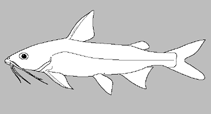
Cathorops manglarensis is distinguished from all congeners through the following combination of characters: 13-16 gill rakers on first arch; 24-27 anal fin rays; dorsal fin spine shorter than pectoral fin spine; posterior margin of pectoral fin spine with shorter serrations. This species can be further distinguished from each of the other species from the Pacific coast of Central and South America by additional characters. Cathorops manglarensis is distinguished from C. dasycephalus in lacking vomerine tooth plates (vs. vomerine tooth plates present) and an osseous bridge formed by the lateral ethmoid and frontal without granulation (vs. granulated along its entire extension). It differs from C. fuerthii by having a median groove of neurocranium deep and large, with lateral margins regular and progressively narrower posteriorly (vs. median groove narrow and shallow, with irregular margins along its entire extension), anterior nostrils closer to each other (3.6-4.8 vs. 4.9-6.0% SL), longer external mental barbel (19.7-24.4 vs. 15.9–19.7% SL), longer internal mental barbel (12.5–17.9 vs. 10.3–12.9% SL), and longer
anal fin base (21.0–24.5 vs. 17.8–19.4% SL). It differs from C. hypophthalmus in possessing a shorter distance between anterior nostrils (3.6–4.8 vs. 6.9–7.1% SL) and between posterior nostrils (5.2–7.1 vs. 8.2–8.5% SL), larger orbital diameter (3.7–4.8 vs. 3.0–3.5% SL), narrower mouth (8.8–10.5 vs. 13.1–13.2% SL) and with shorter external mental barbel (19.7–24.4 vs. 34.5–38.1% SL), internal mental barbel (12.5–17.9 vs.
26.1–31.2% SL), and dorsal fin spine (16.9–19.2 vs. 25.0–25.2% SL). Cathorops manglarensis differs from C. multiradiatus in possessing a longer maxillary barbel (28.4–38.2 vs. 22.9–27.7% SL) and pectoral fin spine (18.5–22.5 vs. 16.9–18.7% SL), and longer and wider accessory tooth plates with large and numerous molariform teeth (vs. shorter and narrow accessory tooth plates with small and few molariform teeth). Cathorops manglarensis differs from C. tuyra in possessing a longer internal mental barbel (12.5–17.9 vs. 8.20–12.4% SL) and pectoral fin spine (18.5–22.5 vs. 16.9–18.7% SL), shorter nuchal plate (5.0–6.8 vs. 6.8–7.5% SL), longer anal fin base (21.0–24.5 vs. 13.9–18.3% SL), deeper caudal peduncle (7.8–8.9 vs. 5.8–7.8% SL), and accessory tooth plates and dentary with moderately large molariform teeth (vs. accessory
tooth plates and dentary with very large molariform teeth) (Ref. 58753).
دورة الحياة وسلوك التزاوج
النضج | التكاثر | وضع البيض | بيض | الخصوبة | اليرقات
Marceniuk, A.P., 2007. Description of Cathorops manglarensis, a new species from the Colombian Pacific, with redescription of Cathorops multiradiatus (Siluriformes; Ariidae). Zootaxa 1529:33-48. (Ref. 58753)
حالة القائمة الحمراء للاتحاد الدولي لحفظ الطبيعة والموارد الطبيعية (Ref. 130435: Version 2025-2 (Global))
خطر للأنسان
Traumatogenic (Ref. 58010)
استخدامات بشرية
مصائد: تجاري
أدوات
تقارير خاصة
تنزيل XML
مصادر علي الأنترنت
تقديرات تستند إلى النماذج
مؤشر التنوع الشُعبي الوراثي (مرجع
82804): PD
50 = 0.5000 [Uniqueness, from 0.5 = low to 2.0 = high].
Bayesian length-weight: a=0.00468 (0.00245 - 0.00892), b=3.13 (2.96 - 3.30), in cm total length, based on LWR estimates for this (Sub)family-body shape (Ref.
93245).
مستوى غذائي (مرجع
69278): 4.2 ±0.8 se; based on size and trophs of closest relatives
ضعف الصيد (Ref.
59153): Low vulnerability (14 of 100).
🛈