>
Siluriformes (Catfishes) >
Callichthyidae (Callichthyid armored catfishes) > Corydoradinae
Etymology: ortegai: Named for Hernán Ortega Torres, curator of the fish collection of the Museo de Historia Natural, Universidad Nacional Mayor de San Marcos, in recognition of his deep interest in the freshwater fish fauna of Peru.
Eponymy: Dr Hernán Ortega Torres is a Peruvian ichthyologist at the National University of San Marcos, Lima, where he is Professor and Curator of the fish collection in the university’s Museum of Natural History. [...] (Ref. 128868), visit book page.
Milieu: milieu / Klimaatzone / Diepte / verspreidingsgebied
Ecologie
; zoet water demersaal. Tropical
South America: lower Río Putumayo in Peru.
Grootte / Gewicht / Leeftijd
Maturiteit: Lm ? range ? - ? cm
Max length : 4.5 cm mannelijk / geslacht onbekend; (Ref. 89658)
Korte beschrijving
Determinatiesleutels | Morfologie | Morfometrie
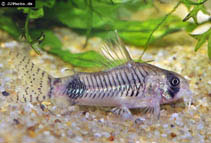
Dorsale stekels (totaal) : 2; Dorsale zachte stralen (totaal) : 8 - 9; Anale zachte stralen: 7. Diagnosed from all congeners, except Corydoras panda, Corydoras reynoldsi, Corydoras weitzmani, and Corydoras tukano, by having a transverse, dark bar
(mask) across the orbit, and ground color of body uniform with large, dark rounded blotch midlaterally on trunk below adipose fin. Can be differentiated from Corydoras reynoldsi, Corydoras weitzmani, and Corydoras tukano by the absence of a midlateral trunk blotch at the dorsal-fin level, and the rounded shape of the trunk blotch at adipose-fin level. Differs from Corydoras panda by having more lateral body plates (24 dorsolateral/ 21-22 ventrolateral vs. 22-23/20), the absence of dark brown dorsal-fin blotch (vs. presence), several scattered chromatophores surrounding yellowish white area on midregion of cleithrum (vs. chromatophores absent or nearly absent on cleithrum), caudal fin with narrow series of dark brown blotches restricted to rays (vs. caudal fin hyaline), a slenderer body (depth of body 28.3-35.1% SL vs. 40.0% SL), and a narrower intercleithral area (maximum cleithral width 10.7-15.5% SL vs. 18% SL). Additional character that distinguishes this species
from its congeners includes the unique condition of its inner mental barbels, which are distinctly separated only at their distal tips (vs. barbels distinctly separated along their entire lengths). This feature is variable among Corydoras ortegaispecimens, although this is an exclusive character-state among corydoradine catfishes (Ref. 58938).
Body shape (shape guide): fusiform / normal.
Facultative air-breathing (Ref. 126274); Occurs mainly in lotic habitats characterized by muddy-brown color, soft bottom of clay and sand where it is relatively abundant (Ref. 58938).
Levenscyclus en paargedrag
Maturiteit | Voortplanting | Paaien | Eieren | Fecunditeit | Larven
Britto, M.R., F.C.T. Lima and M.H. Hidalgo, 2007. Corydoras ortegai, a new species of corydoradine catfish from the lower río Putumayo in Peru (Ostariophysi: Siluriformes: Callichthyidae). Neotrop. Ichthyol. 5(3):293-300. (Ref. 58938)
Status op de Rode Lijst van het IUCN (Ref. 130435: Version 2025-2 (Global))
Gevaar voor de mens
Harmless
Gebruik door de mens
Tools
Speciale rapporten
Download XML
Internetbronnen
Schattingen op basis van modellen
Fylogenetische diversiteitsindex (Ref.
82804): PD
50 = 0.5000 [Uniqueness, from 0.5 = low to 2.0 = high].
Bayesian length-weight: a=0.01778 (0.00758 - 0.04173), b=3.02 (2.82 - 3.22), in cm total length, based on LWR estimates for this (Sub)family-body shape (Ref.
93245).
Trofisch niveau (Ref.
69278): 3.0 ±0.4 se; based on size and trophs of closest relatives
Weerstandsvermogen (Ref.
120179): Hoog, minimale populatieverdubbelingstijd minder dan 15 maanden (Preliminary K or Fecundity.).
Kwetsbaarheid van de visserij (Ref.
59153): Low vulnerability (10 of 100).
🛈