التصنيف / الأسماء
الأسماء الشائعة | مرادفات | Catalog of Fishes(جنس, الانواع) | ITIS | CoL | WoRMS | Cloffa
>
Cyprinodontiformes (Rivulines, killifishes and live bearers) >
Nothobranchiidae (African rivulines)
Etymology: Nothobranchius: Greek, nothos = false + Greek, brangchia = gill (Ref. 45335); hengstleri: Named in honour of the collector, Mr. Holger Hengstler of Munich, Germany (Ref. 58960).
Eponymy: Holger Hengstler of Munich is an aquarist who collected the type in northern Mozambique. [...] (Ref. 128868), visit book page.
البيئة: الوسط / المنطقة المناخية / نطاق العمق / نطاق التوزيع
البيئة
; المياه العذبة محيطي. Tropical
Africa: near Nassoro village, Cabo Delgado Province, northeastern Mozambique (Ref. 58960).
الحجم / وزن / العمر
النضج: Lm ? range ? - ? cm
Max length : 4.1 cm SL ذكر/ مختلط الجنس; (Ref. 58960); 4.1 cm SL (female)
وصف مختصر
مفاتيح التعريف | الوصف الخارجي | قياسات المظهر الخارجي
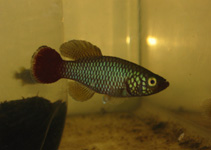
الأشواك الظهرية (المجموع) : 0; الأشعة الظهرية الناعمة (المجموع) : 13 - 16; شوكة شرجية: 0; أشعه شرجية لينه: 14 - 16. Diagnosis: Nothobranchius hengstleri is distinguished from N. melanospilus and N. cf. melanospilus on the basis of male and female colouration, and by a more convex dorsal profile; male N. hengstleri differs from male N. melanospilus in having a greater body depth, 30.4-31.8% of standard length vs. 29.3-30.3%, a longer head, 33.3-33.5% of standard length vs. 26.8-28.3%, a longer prepelvic length, 49.6-50.1% of standard length vs. 45.6-48.9%; males and females have fewer scales in longitudinal series, 25-26 vs. 31-32; male N. hengstleri differs from male N. cf. melanospilus in having a greater body depth, 30.5-31.8% of standard length vs. 25.6-28.2%, a longer head, 33.3-33.5% of standard length vs. 29.5-32.6%; males and females have fewer scales in the longitudinal series, 25-26 vs. 29-30; males differ from males of the other two species in having a deeper red colouration over the entire body and head, a spotted anal fin, well defined brown spots over entire fin vs. few spots limited at base, a different caudal-fin pattern, deep red, with a well defined complete black margin vs. red, without any particular marking or with thin rudimentary black margin sometimes reduced on upper and lower angle, and a different caudal fin shape, perfectly rounded vs. rounded to subtruncate; female N. hengstleri differ from female N. melanospilus by the spots on body and fins, absent vs. present, and by the caudal fin shape indicated immediately before; they also differ from female N. cf. melanospilus by the spots on body and fins, absent vs. present but rudimentary in some populations, absent in other populations (Ref. 59960). Among other closely related species, male N. hengstleri differs from male N. vosseleri in having a longer head, 33.3-33.5% of standard length vs. 25.1-31.5%, anal fin pattern, spots forming approximately three or four arch-like stripes in middle part of fin vs. small spots extending on fin rays and irregular stripes, male N. vosseleri from Korogwe area by dorsal and anal fins colouration, yellow-green vs. yellow-grey to pale blue, males and females with fewer scales in longitudinal series, 25-26 vs. 25-31, and fewer anal fin rays, 14-16 vs. 15-18 (Ref. 58960). Male N. hengstleri differs from male N. interruptus in having a deeper red colouration over the entire body and head, caudal fin colouration, deep red with complete black margin vs. pale to clear red with irregular blue-grey to almost colourless border, dorsal fin colouration yellow-green, with red to brown spots vs. blue-grey to olive with dark grey spots, anal fin colouration yellow-green with red/brown spots vs. olive-yellow to pale blue with some grey spots near fin base, males and females with fewer scales in longitudinal series, 25-26 vs. 27-32, and caudal fin shape perfectly rounded vs. subtruncate (Ref. 58960). Male N. hengstleri differs from male N. jubbi in having a deeper red colouration over the entire body and head, dorsal fin colouration yellowish with red/brown spots vs. blue-grey to olive with red brown spots, anal fin colouration yellow-green, with red-brown spots vs. olive-yellow to pale blue with some grey spots near fin base, caudal fin colouration deep red with complete black margin vs. blue-grey with a pattern of red-brown spots and a white margin in blue morph and clear red followed by a wide blue-grey band and white border in red morph, female N. hengstleri differs from female N. jubbi in body and unpaired fins pattern not marked vs. dark border on body scales and small dark grey marking at base of fins, males and females with fewer scales in longitudinal series, 25-26 vs. 29-32, fewer dorsal fin rays, 13-16 vs. 15-20, fewer anal fin rays, 14-16 vs. 15-19, and caudal fin shape perfectly rounded vs. subtruncate (Ref. 58960). Male N. hengstleri differs from male N. elongatus in having a deeper red colouration over the entire body and head, anal fin colouration yellow-green, with red/brown spots vs. yellow-grey with few red spots near fin base, males and females have fewer scales in longitudinal series, 25-26 vs. 30-32, fewer anal fin rays, 14-16 vs. 16-18, and caudal fin shape perfectly rounded vs. subtruncate (Ref. 58960).
Body shape (shape guide): fusiform / normal.
Type locality is a temporary pool of about 6 m long, 1.5 m wide and 0.10 m deep; no aquatic vegetation present, only dry grass along the shore; water brown and turbid; pH 7.5; no other fish present (Ref. 58960).
دورة الحياة وسلوك التزاوج
النضج | التكاثر | وضع البيض | بيض | الخصوبة | اليرقات
Valdesalici, S., 2007. A new species of the genus Nothobranchius (Cyprinodontiformes: Nothobranchiidae) from the coastal area of northeastern Mozambique. Zootaxa 1587:61-68. (Ref. 58960)
حالة القائمة الحمراء للاتحاد الدولي لحفظ الطبيعة والموارد الطبيعية (Ref. 130435: Version 2025-2 (Global))
في خطر (EN) (B1ab(iii)+2ab(iii)); Date assessed: 25 April 2014
استخدامات بشرية
مصائد: غير ذات اهمية
أدوات
تقارير خاصة
تنزيل XML
مصادر علي الأنترنت
تقديرات تستند إلى النماذج
مؤشر التنوع الشُعبي الوراثي (مرجع
82804): PD
50 = 0.5000 [Uniqueness, from 0.5 = low to 2.0 = high].
Bayesian length-weight: a=0.01096 (0.00461 - 0.02608), b=2.94 (2.74 - 3.14), in cm total length, based on LWR estimates for this (Sub)family-body shape (Ref.
93245).
مستوى غذائي (مرجع
69278): 3.2 ±0.4 se; based on size and trophs of closest relatives
ضعف الصيد (Ref.
59153): Low vulnerability (10 of 100).
🛈