Klassificering / Namn
Populärnamn | synonymer | Catalog of Fishes(Släkte, Arter) | ITIS | CoL | WoRMS | Cloffa
>
Siluriformes (Catfishes) >
Phreatobiidae (Cistern catfishes)
Etymology: Phreatobius: Greek, phreas, -atos = well, spring + Greek, bios = alive (Ref. 45335); sanguijuela: The specific name refers to the local name of this catfish in Bolivia.
Miljö: miljö / Klimatzon / djupintervall / distributionsområde
Ekologi
; sötvatten bottenlevande. Tropical
South America: artificial wells near Río Paraguá, a tributary of the Río Iténez in Bolivia.
Storlek / Vikt / Ålder
Könsmognad: Lm ? range ? - ? cm
Max length : 4.2 cm SL hane/ej könsbestämd; (Ref. 59347)
Kort beskrivning
Bestämningsnycklar | Morfologi | Morfometri
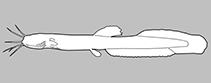
Taggstrålar i ryggfenan (totalt) : 0; Mjukstrålar i ryggfenan (totalt) : 7; Mjukstrålar i analfenan: 19 - 20; Ryggkotor: 45 - 46. Distinguished from other siluriform genera by having the following combination of characters: dorsal and ventral procurrent caudal-fin rays extended rostrally, dorsally reaching a vertical position on dorsal-fin base posterior to dorsal-fin insertion, ventrally continuous with anal fin; caudal fin round; all anal-fin rays unbranched; mouth prognathous, with jaws displaced dorsally on head; adductor mandibulae muscle hypertrophied, covering most of skull and inserting posteriorly onto first neural spine; first pectoral-fin ray soft, not spinous; bright red in life. Differs uniquely from its congeners by the absence of eyes, presence of 25-34 dorsal procurrent caudal fin rays; 14-16 ventral procurrent caudal fin rays; 45-46 vertebrae (Ref. 59347).
Body shape (shape guide): elongated; Cross section: circular.
Occurs in artificial wells with transparent water, depth range 6 to 12 m and diameter of approximately 1 m (Ref. 59347). The water in the wells is used locally for human consumption. This fish is often mistaken for parasitic leeches " sanguijuelas" due to its bright, blood-red color and vermiform shape. For this reason, this is killed upon incidental capture when extracting drinking water from wells.
Livscykel och parningsbeteende
Könsmognad | Reproduktion | Lek | Ägg | Fekunditet | Larver
Fernández, L., L.J. Saucedo, F.M. Carvajal-Vallejos and S.A. Schaefer, 2007. A new phreatic catfish of the genus Phreatobius Goeldi 1905 from groundwaters of the Iténez River, Bolivia (Siluriformes: Heptapteridae). Zootaxa 1626:51-58. (Ref. 59347)
Status på IUCN:s rödlista (Ref. 130435: Version 2025-2 (Global))
Hot mot människor
Harmless
Mänskliga användningsområden
Verktyg
Särskilda rapporter
Ladda ner XML
Internet-källor
Uppskattningar baserade på modeller
Index för fylogenetisk mångfald (Ref.
82804): PD
50 = 0.7500 [Uniqueness, from 0.5 = low to 2.0 = high].
Bayesian length-weight: a=0.00389 (0.00180 - 0.00842), b=3.12 (2.94 - 3.30), in cm total length, based on all LWR estimates for this body shape (Ref.
93245).
Trofisk nivå (Ref.
69278): 3.1 ±0.5 se; based on size and trophs of closest relatives
Sårbarhet i fisket (Ref.
59153): Low vulnerability (10 of 100).
🛈