Classification / Noms
Noms communs | Synonymes | Catalog of Fishes(Genre, Espèce) | ITIS | CoL | WoRMS | Cloffa
>
Siluriformes (Catfishes) >
Mochokidae (Squeakers or upside-down catfishes) > Mochokinae
Etymology: Synodontis: Greek, syn, symphysis = grown together + Greek, odous = teeth (Ref. 45335); lucipinnis: The specific name is a combination of the Latin luci, meaning bright or clear, and the Latin pinnis, meaning fin, a reference to the light patches found at the base of the black triangles found on the rayed fins of this species (Ref. 59365).
Environnement : milieu / zone climatique / profondeur / gamme de distribution
Écologie
; eau douce démersal. Tropical
Africa: endemic to Lake Tanganyika, only known from the type locality in Zambia (Ref. 59365).
Taille / Poids / Âge
Maturité: Lm ? range ? - ? cm
Max length : 7.9 cm SL mâle / non sexé; (Ref. 59365)
Description synthétique
Clés d'identification | Morphologie | Morphométrie
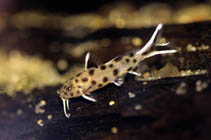
Épines dorsales (Total) : 2; Rayons mous dorsaux (Total) : 7 - 8; Épines anales: 0; Rayons mous anaux: 12 - 13; Vertèbres: 34 - 35. Body is not compressed; predorsal profile is slightly convex; skin on body forming numerous vertical folds; papillae absent; head slightly depressed and broad (Ref. 59365). Eyes dorsolateral, ovoid, its diameter 25.2-35.8% of snout length (Ref. 59365). Mandibular teeth 35-51, short and unicuspid, arranged in 6 short, transverse rows (Ref. 59365). Maxillary barbel short, extending at least to base of pectoral spine, with small papillae at base and narrow basal membrane; lateral mandibular barbel extending to point just past anterior margin of pectoral girdle, with 4-6 short, simple, weakly tuberculate branches, usually lacking secondary branches; medial mandibular barbel approximately 1/3 to 1/2 length of lateral barbel, with 4-6 pairs of tuberculate branches, many secondary branches present (Ref. 59365). Dorsal fin spine short, striated, slightly curved, terminating in a short, white filament; anterior margin of spine smooth, posterior margin with small serrations distally (Ref. 59365). Pectoral fin spine roughly equal in length to dorsal fin spine, striated, slightly curved, terminating in short, white filament; anterior spine margin smooth, posterior margin with large, retrorse serrations along entire length (Ref. 59365). Adipose fin long, well dveloped, margin convex (Ref. 59365). Body with large spots, fin spines white (Ref. 59365).
Body shape (shape guide): fusiform / normal.
This species can be found in rocky, coastal areas; no information on maximum depth, diet or reproduction (Ref. 59365).
Cycle de vie et comportement reproducteur
Maturité | Reproduction | Frai | Œufs | Fécondité | Larves
Wright, J.J. and L.M. Page, 2006. Taxonomic revision of Lake Tanganyikan Synodontis (Siluriformes: Mochokidae). Bull. Florida Mus. Nat Hist. 46(4):99-154. (Ref. 59365)
Statut dans la liste rouge de l'IUCN (Ref. 130435: Version 2025-2 (Global))
Menace pour l'homme
Harmless
Utilisations par l'homme
Outils
Articles particuliers
Télécharger en XML
Sources Internet
Estimations basées sur des modèles
Indice de diversité phylogénétique (Réf.
82804): PD
50 = 0.5000 [Uniqueness, from 0.5 = low to 2.0 = high].
Bayesian length-weight: a=0.01445 (0.00659 - 0.03170), b=2.90 (2.72 - 3.08), in cm total length, based on LWR estimates for this Genus-body shape (Ref.
93245).
Niveau trophique (Réf.
69278): 2.9 ±0.4 se; based on size and trophs of closest relatives
Résilience (Réf.
120179): Haut, temps minimum de doublement de population inférieur à 15 mois (Preliminary K or Fecundity.).
Vulnérabilité de la pêche (Ref.
59153): Low vulnerability (10 of 100).
🛈