>
Ovalentaria/misc (Various families in series Ovalentaria) >
Pomacentridae (Damselfishes) > Chrominae
Etymology: Chromis: Greek, chromis = a fish, perhaps a perch (Ref. 45335); earina: Name from Latinized form of the Greek adjective 'earinos' meaning 'the color of spring', which is green; referring to the pale green color of this species in life.
Milieu: milieu / Klimaatzone / Diepte / verspreidingsgebied
Ecologie
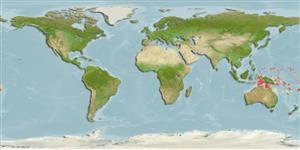
marien rifbewoner; diepte 60 - 116 m (Ref. 59379). Tropical; 9°N - 21°S, 129°E - 178°W
Western Pacific: from Puluwat westward to Palau; south to Papua New Guinea, Vanuatu and Fiji; also Indonesia. It was not observed at Rarotonga (Cook Islands), Kiritimati (Line Islands), nor American Samoa during brief surveys of deep reefs at these localities.
Grootte / Gewicht / Leeftijd
Maturiteit: Lm ? range ? - ? cm
Max length : 6.6 cm SL mannelijk / geslacht onbekend; (Ref. 59379)
Korte beschrijving
Determinatiesleutels | Morfologie | Morfometrie
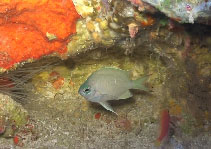
Dorsale stekels (totaal) : 12 - 13; Dorsale zachte stralen (totaal) : 11 - 12; Anale stekels: 2; Anale zachte stralen: 12. This species is distinguished by the following characters: Dorsal rays XII-XIII, 11-12, usually XIII, 12; anal rays II, 12; pectoral rays 17-18, usually 18; spiniform caudal rays 3; tubed lateral-line scales 13-15, rarely 16; gill rakers 6-8 + 18-21 (total 26-28, rarely 25); body depth 1.65-1.9 in SL. The color when fresh is pale slate blue (bright pale green in life) with a white spot (sometimes two white spots) roughly the size of a scale mid-laterally on the body; malachite green area above orbit and in inter-orbital space and nape; the dorsal and anal fins with bright distal border of pale turquoise blue (Ref. 59379).
Body shape (shape guide): short and / or deep; Cross section: compressed.
Adults inhabit steep outer reef slopes and drop-offs with rocky outcrops and small caves and holes, often in association with limestone talus; usually observed in pairs or small groups, feeding low in the water column, and are generally abundant where they are found (Ref. 59379). Oviparous, distinct pairing during breeding (Ref. 205). Eggs are demersal and adhere to the substrate (Ref. 205). Males guard and aerate the eggs (Ref. 205).
Levenscyclus en paargedrag
Maturiteit | Voortplanting | Paaien | Eieren | Fecunditeit | Larven
Oviparous, distinct pairing during breeding (Ref. 205). Eggs are demersal and adhere to the substrate (Ref. 205). Males guard and aerate the eggs (Ref. 205).
Pyle, R., J.L. Earle and B.D. Greene, 2008. Five new species of the damselfish genus Chromis (Perciformes: Labroidei: Pomacentridae) from deep coral reefs in the tropical western Pacific. Zootaxa 1671:3-31. (Ref. 59379)
Status op de Rode Lijst van het IUCN (Ref. 130435: Version 2025-2 (Global))
Gevaar voor de mens
Harmless
Gebruik door de mens
Tools
Speciale rapporten
Download XML
Internetbronnen
Schattingen op basis van modellen
Gewenste temperatuur (Ref.
123201): 25.6 - 27.6, mean 26.5 °C (based on 50 cells).
Fylogenetische diversiteitsindex (Ref.
82804): PD
50 = 0.5000 [Uniqueness, from 0.5 = low to 2.0 = high].
Bayesian length-weight: a=0.01778 (0.00800 - 0.03953), b=3.00 (2.82 - 3.18), in cm total length, based on LWR estimates for this Genus-body shape (Ref.
93245).
Trofisch niveau (Ref.
69278): 3.0 ±0.1 se; based on size and trophs of closest relatives
Weerstandsvermogen (Ref.
120179): Hoog, minimale populatieverdubbelingstijd minder dan 15 maanden (Preliminary K or Fecundity.).
Kwetsbaarheid van de visserij (Ref.
59153): Low vulnerability (10 of 100).
🛈