>
Eupercaria/misc (Various families in series Eupercaria) >
Sparidae (Porgies)
Etymology: Acanthopagrus: Greek, akantha = thorn + Greek, pagros, a kind of fish (Ref. 45335).
Ambiente: milieu / zona climatica / distribuzione batimetrica / gamma di distribuzione
Ecologia
marino; acqua dolce; salmastro demersale. Subtropical; 34°N - 15°N, 105°E - 137°E
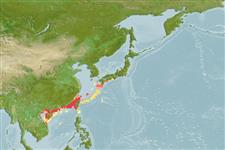
Northwest Pacific: limited to the east Asia Shelf, recorded only from the coasts of Honshu (including Seto Inland Sea), Shikoku and Kyushu Is., Japan (not Ryukyu and Ogasawara Is. or Sea of Japan), southern Korea, Taiwan, China (from around Shanghai to southern China) and northern Vietnam (south to Hué). Previous reports from other areas of the Indo-Pacific are misidentifications of species within the A. latus species complex.
Lunghezza alla prima maturità / Dimensione / Peso / Età
Maturità: Lm 24.4 range ? - ? cm
Max length : 40.0 cm FL maschio/sesso non determinato; (Ref. 108874); peso massimo pubblicato: 1.5 kg (Ref. 40637)
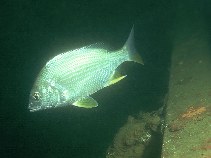
Spine dorsali (totale) : 11; Raggi dorsali molli (totale) : 10 - 11; Spine anali: 8 - 9; Vertebre: 24. This species is distinguished from its congeners by the following set of characteristics: generally deep body in young specimens, becoming slender in larger adults, 2.14-2.70 (mean 2.42) times in SL: D usually XI,11 (very rarely XI,10); scale rows between fifth dorsal-fin spine and lateral line 3.5-4.5 (3.5 often observed in northwestern Kyushu Island and Seto Inland Sea, Japan, southern Korea and Vietnam, and in pre c. 1980 specimens in China, Taiwan and Japan; pers. obs.); scale rows above lateral line 4.5-5.5, scale rows below 10.5-12.5; second anal-fin spine longer than third anal-fin spine [14.6-24.8% (mean 20.6%) of SL], 1.19-1.58 (mean 1.40) in 2AS and 3AS; pored
lateral-line scales 44-47 (mean 45.2); the first soft dorsal-fin ray slightly longer than last dorsal-fin
spine; color of pelvic, anal and caudal fins mostly whitish yellow to strong vivid yellow, except contrasting lower yellow margin on caudal fin; black streaks near anal-fin base on inter-radial membranes between yellow anal-fin rays, even in preserved specimens; no black blotches on inter-radial membranes between dorsal-fin rays; a weak diffuse dark blotch at origin of lateral line (usually covering region of first pored lateral-line scale) continuing as relatively dense blackish shading on upper part of posterior opercle (Ref. 93743).
Body shape (shape guide): short and / or deep; Cross section: compressed.
This species inhabits warm shallow and coastal waters, often entering river mouths and estuaries (Ref. 93743). Used in Chinese medicine (Ref. 12166). It is parasitised by the monogenean Anoplodiscus australis on the fins and body surface (Ref. 124057).
Ciclo vitale e comportamento di accoppiamento
Maturità | Riproduzione | Deposizione | Uova | Fecondità | Larve
Iwatsuki, Y., 2013. Review of the Acanthopagrus latus complex (Perciformes: Sparidae) with descriptions of three new species from the Indo-West Pacific Ocean. J. Fish Biol. 83(1):64-95. (Ref. 93743)
Stato della Lista Rossa IUCN (Ref. 130435: Version 2025-2 (Global))
Minaccia per l'uomo
Harmless
Usi umani
Pesca: commerciale; Acquacoltura: commerciale; Pesce da pesca sportiva: si
Strumenti
Rapporti speciali
Scarica XML
Fonti Internet
Stime basate su modelli
Temperatura preferita (Fonte Biblio.
123201): 21.7 - 28.5, mean 27.4 °C (based on 644 cells).
Indice di diversità filogenetica (Fonte Biblio.
82804): PD
50 = 0.5000 [Uniqueness, from 0.5 = low to 2.0 = high].
Bayesian length-weight: a=0.01622 (0.01306 - 0.02014), b=2.96 (2.92 - 3.00), in cm total length, based on LWR estimates for this species (Ref.
93245).
Livello trofico (Fonte Biblio.
69278): 3.8 ±0.43 se; based on food items.
Resilienza (Fonte Biblio.
120179): Medio, tempo minimo di raddoppiamento della popolazione 1.4 - 4.4 anni (K=0.21; Fec=1,811,434).
Prior r = 0.53, 95% CL = 0.35 - 0.79, Based on 1 data-limited stock assessment.
Vulnerabilità della pesca (Ref.
59153): Moderate vulnerability (38 of 100).
🛈
Vulnerabilità climatica (Ref.
125649): Moderate to high vulnerability (46 of 100).
🛈
Nutrienti (Ref.
124155): Calcium = 87.2 [43.9, 161.3] mg/100g; Iron = 1.02 [0.56, 2.12] mg/100g; Protein = 19.6 [18.5, 20.8] %; Omega3 = 0.31 [0.18, 0.53] g/100g; Selenium = 19.5 [9.0, 40.3] μg/100g; VitaminA = 8.92 [2.50, 30.68] μg/100g; Zinc = 0.745 [0.490, 1.109] mg/100g (wet weight);