Elasmobranquios (tiburones y rayas) (sharks and rays) >
Rhinopristiformes (Shovelnose rays) >
Rhinobatidae (Guitarfishes)
Etymology: Rhinobatos: Greek, rhinos = nose + Greek, batis, -idos = a ray (Raja sp.) (Ref. 45335); penggali: Name from the Indonesian word 'penggali', meaning shovel; refers to the common name used to describe the shape of the head in this groups of rays.
More on authors: Last, White & Fahmi.
Entorno: milieu / zona climática / rango de profundidad / gama de distribución
Ecología
marino bentopelágico. Tropical; 8°S - 10°S, 105°E - 116°E (Ref. 114953)
Eastern Indian Ocean: endemic to central Indonesia.
Longitud en la primera madurez / Tamaño / Peso / Edad
Madurez: Lm 85.5, range 75 - 96 cm
Max length : 86.4 cm TL macho / no sexado; (Ref. 72461); 99.2 cm TL (female)
Descripción breve
Claves de identificación | Morfología | Morfometría
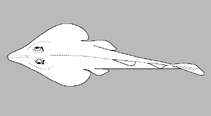
This species is distinguished by the following set of adult characters: disc broadly wedge-shaped, width 36-37% TL, length less than 1.3 (1.20-1.27) times width; snout moderately elongate, length 3-3.2 times interspiracular distance, 4-4.5 times interorbital width; orbit medium-sized, 1.4-1.6 times spiracle length; nostrils weakly oblique, length 1.3-1.4 times internarial distance; preoral length 6.9-7.1 times internarial distance; anterior nasal flaps penetrating slightly into internarial space, well separated at their insertion; posterior nasal flaps broad; two spiracular folds, outermost fold about twice height of inner fold; ridges of rostral cartilage almost parallel, converging slightly anteriorly, not constricted medially; anterior cartilage narrow, subtruncate to bilobed posteriorly; distance between fifth gill slits 2.6-3 times in ventral head length; prebranchial sensory pore patch distinct, extending to first gill slit; postscapular sensory canal obscure, exposed lateral pores absent, not grooved; thorn patches on supraorbit, scapular region, dorsal midline, small but distinct; pelvic-fin inner margin slightly shorter than its base; interdorsal distance more than 2.5 (2.7-2.9) times first dorsal-fin base; dorsal caudal margin 2.1-2.6 times preventral margin; upper teeth in 75-83 rows; post-synarcual centra 166-170; nasal lamellae more than 50 (53-57); dorsal fin obviously bicolored; dorsal disc with white spots (sometimes faint) (Ref. 72461).
Body shape (shape guide): elongated.
Demersal inshore on inner insular shelf. Feeds on small crustaceans and probably small bony fishes. Males mature at 70-72 cm TL, females at 75 cm TL. Females have litters of 4-13 pups (Ref. 114953). Caught by fisherman using small demersal gill and trammel nets, and small demersal longlines (Ref. 72461).
Ciclo vital y comportamiento de apareamiento
Madurez | Reproducción | Puesta | Huevos | Fecundidad | Larva
Last, P.R., W.T. White and Fahmi, 2006. Rhinobatos jimbaranensis and R. penggali, two new shovelnose rays (Batoidea: Rhinobatidae) from eastern Indonesia. Cybium 30(3):261-271. (Ref. 72461)
Situación en la Lista Roja de la UICN (Ref. 130435: Version 2025-2 (Global))
Amenaza para el ser humano
Harmless
Usos humanos
Herramientas
Informes especiales
Descargar XML
Fuentes de Internet
Estimaciones basadas en modelos
Índice de diversidad filogenética (Referencia
82804): PD
50 = 0.5000 [Uniqueness, from 0.5 = low to 2.0 = high].
Bayesian length-weight: a=0.00295 (0.00150 - 0.00581), b=3.13 (2.96 - 3.30), in cm total length, based on LWR estimates for this (Sub)family-body shape (Ref.
93245).
Nivel trófico (Referencia
69278): 3.8 ±0.4 se; based on size and trophs of closest relatives
Resiliencia (Referencia
120179): Bajo, población duplicada en un tiempo mínimo de 4.5-14 años (Preliminary low fecundity).
Vulnerabilidad pesquera (Ref.
59153): High vulnerability (60 of 100).
🛈