Ikan bertulang rawan (sharks and rays) >
Carcharhiniformes (Ground sharks) >
Pentanchidae (Deepwater catsharks)
Etymology: Parmaturus: parma (L.), from parme (Gr.), small shield; oura (Gr.), tail, presumably referring to upper edge of caudal fin “armed with modified” scales (per Garman 1913) (See ETYFish); albipenis: albus (L.), white; penis (L.), copulatory organ, referring to white claspers, which contrast strongly against dark brownish body coloration (See ETYFish).
More on authors: Séret & Last.
Lingkungan: lingkungan / zona iklim / kisaran kedalaman / jangkauan distribusi
Ekologi
laut batidemersal; kisaran kedalaman 688 - 732 m (Ref. 74543). Deep-water
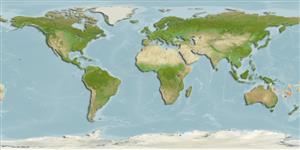
Western Pacific: New Caledonia.
Ukuran / Berat / umur
Kematangan: Lm ? range ? - ? cm
Max length : 41.5 cm TL jantan/; (Ref. 74543)
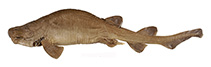
This scyliorhinid catshark is distinguished by the following set of characters: a soft body with velvety skin, with small, tricuspidate denticles; whitish claspers, contrasting with the brownish body coloration; presence of caudal crests but denticles are not enlarged, the crests reaching almost to second dorsal and anal-fin insertions; teeth tri- or quadricuspidate, in the upper jaw about 130 rows; first dorsal fin slightly in front middle of back, pre-first dorsal length 46.2% TL, origin slightly in front of pelvic-fin origin; pelvic-fin origin slightly in front of midbody, pre-pelvic length 47.1% TL; vent slightly behind mid-body, pre-vent length 52.0% TL; short snout, prenarial length 4.3% TL; short mouth, its length 3.1% TL; very short labial furrows, confined to mouth corners; head is shorter than abdomen, head length 19.8% TL, pectoral-pelvic length 24.2% TL; dorsal fins are large, subequal in size, anterior margins about 11.3% TL, with the first dorsal more erect than second; well-developed subterminal caudal lobe , subterminal margin length 5.7% TL, terminal margin length 5.1% TL; 39 monospondylous centra; 79 precaudal centra, 123 total (Ref. 74543).
Body shape (shape guide): elongated.
Siklus hidup dan perilaku kawin
Kematangan | Reproduksi, perkembang biakan | Pemijahan | telur-telur | Fekunditas | Larva
Séret, B. and P. Last, 2007. Four new species of deep-water catsharks of the genus Parmaturus (Carcharhiniformes: Scyliorhinidae) from New Caledonia, Indonesia and Australia. Zootaxa 2007:1-17. (Ref. 74543)
Status IUCN Red List (Ref. 130435: Version 2025-2 (Global))
ancaman kepada manusia
Harmless
penggunaan manusia
Alat, peralatan
laporan khas
muat turun XML
Sumber internet
Estimasi berdasarkan model
Suhu yang disukai (Acuan
123201): 5.8 - 7.1, mean 6.1 °C (based on 7 cells).
Indeks keanekaragaman filogenetik (Acuan
82804): PD
50 = 0.5078 [Uniqueness, from 0.5 = low to 2.0 = high].
Bayesian length-weight: a=0.00347 (0.00172 - 0.00698), b=3.08 (2.90 - 3.26), in cm total length, based on LWR estimates for this (Sub)family-body shape (Ref.
93245).
Tingkat Trofik (Acuan
69278): 4.0 ±0.5 se; based on size and trophs of closest relatives
Daya lenting (Acuan
120179): Tinggi, Waktu penggandaan populasi minimum kurang dari 15 bulan (Preliminary K or Fecundity.).
Kerentanan Penangkapan Ikan (Ref.
59153): Low to moderate vulnerability (32 of 100).
🛈