Klassifizierung / Names
Namen | Synonyme | Catalog of Fishes(Gattung, Arten) | ITIS | CoL | WoRMS | Cloffa
>
Acanthuriformes (Surgeonfishes) >
Leiognathidae (Slimys, slipmouths, or ponyfishes) > Gazzinae
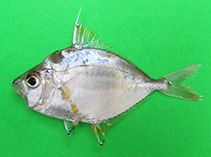
Etymology: flavaxilla: Name from Latin 'flavaxilla' which means 'yellow axil'. referting to the prominent yellowmarking just behind the pectoral fin base.
Umwelt: Milieu / Klimazone / Tiefenbereich / Verbreitungsgebiet
Ökologie
seewasser demersal. Tropical; 12°N - 10°N, 122°E - 123°E
Western Central Pacific: Philippines.
Größe / Gewicht / Alter
Geschlechtsreife: Lm ? range ? - ? cm
Max length : 10.9 cm SL Männchen/unbestimmt; (Ref. 74926)
Rückenflossenstacheln (insgesamt) : 8 - 9; Rückenflossenweichstrahlen (insgesamt) : 15 - 17; Afterflossenstacheln: 3; Afterflossenweichstrahlen: 14. This species is distinguished by the following set of characters: naked cheek and breast; fully scaled dorsolateral body surface; anteroventral profile of lower jaw somewhat strongly concave; upper oral valve with sparse minute, slender papillary projections; bicuspid preorbital spine, not expanded distally; second dorsal and anal fin spines elongated,
almost reaching to the base of fifth dorsal fin soft ray and extending beyond the base of fifth anal fin soft ray when fins are appressed; a distinct yellow semicircular marking just behind pectoral fin base, larger than pupil and smaller than eye in size; usually almost straight dark vertical lines (not wavy) dorsolaterally on the body in preserved specimens (Ref. 74926).
Similar to Nuchequula gerroides and N. longicornis in overall body appearance, naked cheek and breast, and scaled anterior dorsolateral surface of body; however, N. flavaxilla is different from the latter two species by the preorbital spine not expanded distally (vs. expanded distally in the latter two species) (Ref. 74926).
Body shape (shape guide): short and / or deep; Cross section: compressed.
Lebenszyklus und Paarungsverhalten
Geschlechtsreife | Fortpflanzung | Ablaichen | Eier | Fruchtbarkeit | Larven
Kimura, S., R. Kimura and K. Ikejima, 2008. Revision of the genus Nuchequula with descriptions of three new species (Perciformes: Leiognathidae). Ichthyol. Res. 55:22-42. (Ref. 74926)
IUCN Rote Liste Status (Ref. 130435: Version 2025-2 (Global))
Nutzung durch Menschen
Tools
Zusatzinformationen
Download XML
Internet Quellen
Schätzungen auf der Grundlage von Modellen
Phylogenetischer Diversitätsindex (Ref.
82804): PD
50 = 0.5078 [Uniqueness, from 0.5 = low to 2.0 = high].
Bayesian length-weight: a=0.01905 (0.00857 - 0.04236), b=2.95 (2.77 - 3.13), in cm total length, based on LWR estimates for this (Sub)family-body shape (Ref.
93245).
Trophische Ebene (Ref.
69278): 2.9 ±0.3 se; based on size and trophs of closest relatives
Widerstandsfähigkeit (Ref.
120179): hoch, Verdopplung der Population dauert weniger als 15 Monate. (Preliminary K or Fecundity.).
Anfälligkeit der Fischerei (Ref.
59153): Low vulnerability (10 of 100).
🛈