Classificatie / Namen
Lokale namen | Synoniemen | Catalog of Fishes(Genus, Soort(en)) | ITIS | CoL | WoRMS | Cloffa
>
Siluriformes (Catfishes) >
Bagridae (Bagrid catfishes)
Etymology: Pseudomystus: Greek, pseudes = false + Greek, mystax = whiskered, used by Belon in 1553 to describe all fishes with whiskers (Ref. 45335); heokhuii: Named for Heok Hui Tan.
Eponymy: Dr Heok Hui Tan is an ichthyologist who is a lecturer at the National University of Singapore which awarded all his degrees: bachelor’s (1996) master’s (1999) and Doctorate (2003). [...] (Ref. 128868), visit book page.
Milieu: milieu / Klimaatzone / Diepte / verspreidingsgebied
Ecologie
; zoet water demersaal; pH range: 3.5 - 4.5. Tropical
Asia: Batang Hari and Indragiri River drainages in Sumatra, Indonesia.
Grootte / Gewicht / Leeftijd
Maturiteit: Lm ? range ? - ? cm
Max length : 6.4 cm SL mannelijk / geslacht onbekend; (Ref. 74936)
Korte beschrijving
Determinatiesleutels | Morfologie | Morfometrie
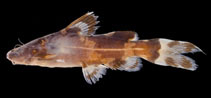
Dorsale stekels (totaal) : 1; Dorsale zachte stralen (totaal) : 7; Anale zachte stralen: 12 - 14; Wervels: 35 - 36. Differs from its congeners in possessing a color pattern consisting of a pale midlateral stripe and two pale oblique bands on the sides of the body; no other congener exhibits a distinct pale midlateral stripe. Can be differentiated further from all congeners except Pseudomystus breviceps, Pseudomystus bomboides, Pseudomystus flavipinnis, Pseudomystus myersi, Pseudomystus siamensis, Pseudomystus robustus, Pseudomystus sobrinus and Pseudomystus stenomus in having a deeper body (17.8-21.0% SL vs. 9.0-17.0). Differs from Pseudomystus leiacanthus in having two (vs. one) dark narrow irregular bars on the caudal fin, longer pectoral spine (19.3-22.4% SL vs. 15.2-18.6), longer caudal fin (33.5-40.0% SL vs. 25.7-31.9) with pointed (vs. rounded) lobes, longer nasal and maxillary barbels (63.1-81.1% HL vs. 31.3-51.5 and 86.2-125.3% HL vs. 70.9-91.3 respectively; nasal barbel reaching to dorsal insertion of opercular flap vs. to just beyond posterior orbital margin and maxillary barbel reaching just beyond base of last pectoral-fin ray vs. to base of pectoral spine), a straight ( vs. crescentic) premaxillary tooth patch, a more sharply tapering snout when viewed dorsally and an even (vs. slightly convex) predorsal profile (Ref. 74936).
Body shape (shape guide): elongated.
Occurs in floodplain channels and peat swamps with very acidic (pH 3.5-4.5), tannin-stained water (Ref. 74936).
Levenscyclus en paargedrag
Maturiteit | Voortplanting | Paaien | Eieren | Fecunditeit | Larven
Lim, K.K.P. and H.H. Ng, 2008. Pseudomystus heokhuii, a new species of bagrid catfish from Sumatra (Teleostei:Bragidae). Zootaxa 1686:37-47. (Ref. 74936)
Status op de Rode Lijst van het IUCN (Ref. 130435: Version 2025-2 (Global))
Gevaar voor de mens
Harmless
Gebruik door de mens
Tools
Speciale rapporten
Download XML
Internetbronnen
Schattingen op basis van modellen
Fylogenetische diversiteitsindex (Ref.
82804): PD
50 = 0.5000 [Uniqueness, from 0.5 = low to 2.0 = high].
Bayesian length-weight: a=0.00871 (0.00415 - 0.01826), b=2.93 (2.76 - 3.10), in cm total length, based on LWR estimates for this (Sub)family-body shape (Ref.
93245).
Trofisch niveau (Ref.
69278): 3.2 ±0.4 se; based on size and trophs of closest relatives
Weerstandsvermogen (Ref.
120179): Hoog, minimale populatieverdubbelingstijd minder dan 15 maanden (Preliminary K or Fecundity.).
Kwetsbaarheid van de visserij (Ref.
59153): Low vulnerability (10 of 100).
🛈